How-to guide
How to Set Your Hourly Rate (What to Charge)
Most freelancers set their rate by taking their old salary, dividing by 2,080 hours, and adding a bit. That calculation is wrong in three separate places, and it's the reason so many people leave employment, work harder, and end up with less money.
It misses that you now pay both halves of payroll tax — the IRS puts self-employment tax at 15.3%, split as 12.4% for Social Security and 2.9% for Medicare, and that's before any income tax. It misses that you now buy your own health insurance, software, equipment, and time off. And it assumes every working hour is a billable hour, which is not true for anybody.
This guide fixes all three. You'll end up with a defensible floor — the rate below which you're losing money — and a target rate that actually pays you what you set out to earn.
Quick answer: the formula
Every term matters, and the denominator matters most — it's the one people get wrong by a factor of two.
Step 1: Set your target income
This is what you want to take home, before tax, for your own labor. Not your old salary — what this business needs to pay you.
Build it from the bottom: your actual annual cost of living, plus what you want to save, plus anything employment used to cover that you now pay for yourself. Health insurance, retirement contributions, and paid time off were all part of your old compensation even though they never appeared on your payslip.
Be specific. "About $80k" produces a rate you can't defend when a client pushes back. $62,400 living + $9,600 retirement + $8,000 health cover = $80,000 is a number you can stand behind.
Step 2: Add your business expenses
These are costs the business incurs to operate — separate from your personal income, and they must be covered by your billing before you're paid anything.
Annual, not monthly. The monthly view is what makes people underestimate:
| Expense | Example annual |
|---|---|
| Software and subscriptions | $1,800 |
| Equipment (amortized over its life) | $1,200 |
| Insurance (liability, professional indemnity) | $900 |
| Accounting and legal | $1,400 |
| Marketing, website, hosting | $1,000 |
| Phone and internet (business share) | $700 |
| Professional development | $800 |
| Bank and payment processing fees | $600 |
| Workspace or co-working | $2,400 |
| Total | $10,800 |
Payment processing deserves a mention because it's invisible until you total it: at roughly 3% on card payments, $100,000 of revenue quietly costs around $3,000. Our payment processors guide covers how much that varies by processor.
Step 3: Account for tax
You are now both employer and employee, which means you pay both halves of Social Security and Medicare. That's the 15.3% self-employment tax — and it sits on top of federal income tax, plus state income tax where you have it.
The practical approach is a set-aside percentage applied to everything you bill. What that percentage should be depends on your state, your filing status, your deductions, and your total income, so there is no universal number worth repeating. What's certain is the 15.3% floor from self-employment tax alone, with income tax layered above it.
Two honest recommendations: build a set-aside into your rate rather than hoping to find the money at filing time, and get the percentage from an accountant for your specific situation — it's a one-hour conversation that pays for itself immediately.
Step 4: Count your real billable hours
Here is where the standard calculation collapses. A full-time year is 40 × 52 = 2,080 hours. You will not bill 2,080 hours. Nobody does.
Two deductions apply, in order.
First, subtract time off. Vacation, public holidays, and sick days are unpaid when you're self-employed:
2,080 − (15 vacation days × 8) − (10 holidays × 8) − (5 sick days × 8) = 1,840 working hours
Second, subtract non-billable work. Sales calls, proposals, invoicing, bookkeeping, marketing, email, admin, and your own training are all real work that no client pays for.
Don't guess this from an industry figure — track your own for two weeks. Count the hours a client was actually charged for and the hours you worked, and you'll have a ratio specific to you.
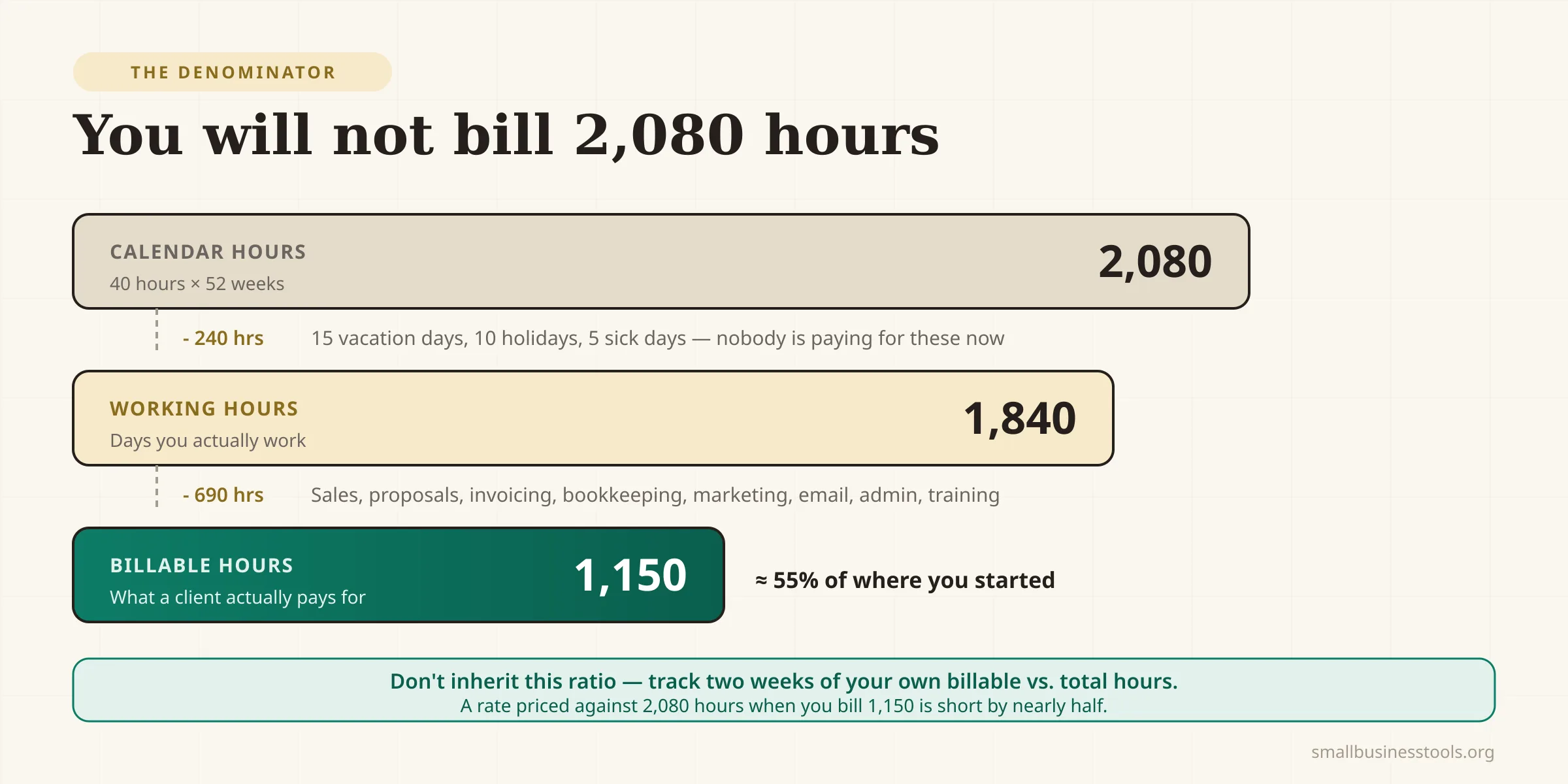
The consequence is direct: a rate calculated against 2,080 hours when you actually bill 1,100 is short by roughly 47%. That single error explains most of the "I'm busy all the time and still broke" experience of early self-employment.
Step 5: Add a profit buffer
Profit is not the same thing as your salary. Your target income in Step 1 pays you for your labor. Profit is what the *business* keeps — the cushion that absorbs a client who doesn't pay, a slow quarter, or a laptop that dies in month three, and eventually funds growth.
If everything you bill is already allocated, then any disruption comes out of your own pocket. A deliberate buffer on top — 10–20% is a reasonable starting point to choose consciously — is what makes the difference between a business and a job with extra paperwork.
Worked example: a freelance designer
Maya leaves an in-house role to freelance. She works through the steps:
| Component | Amount | Notes |
|---|---|---|
| Target income | $80,000 | Living costs + retirement + health cover |
| Business expenses | $10,800 | From the table above |
| Subtotal to cover | $90,800 | |
| Tax set-aside (28%) | $35,311 | Her accountant's figure for her state and situation |
| Total to bill | $126,111 | $90,800 ÷ (1 − 0.28) |
| Profit buffer (10%) | $12,611 | Business cushion |
| Annual billing target | $138,722 | |
| Billable hours | 1,150 | 1,840 working hours, measured 62.5% billable |
| Hourly rate | $121 | $138,722 ÷ 1,150 |
Note how the tax set-aside is calculated: you divide by (1 − rate) rather than multiplying by the rate. To keep $90,800 after a 28% set-aside you must bill $126,111, not $116,224. Multiplying instead of dividing is the second most common error in this calculation, and it leaves you roughly $10,000 short.
Maya's number is $121/hour. Against her old $80,000 salary, dividing by 2,080 gives $38/hour — which is the rate that would have quietly bankrupted her.
The Hourly Rate Calculator runs this whole chain instantly: enter your target income, expenses, billable hours, and tax and profit percentages, and it returns the rate.
Sense-checking the number
Your calculated rate is a floor, not a market price. Two more checks:
- Is it defensible against the market? Look at what comparable providers charge in your region and specialism. If your floor is far above the market, the problem is usually your billable-hours ratio or your expense base, not your ambition. If it's far below, you're underpricing.
- Is it defensible against value? Rate-per-hour is a costing tool, not a pricing strategy. A client cares what the outcome is worth, not what your overhead is. Our pricing strategies guide covers moving from cost-based to value-based pricing — usually the largest single increase available to a service business.
Once your rate is set, the Break-Even Calculator shows how many billable hours a month you need to cover fixed costs — the number that tells you whether a slow month is a problem or a rounding error.
Raising your rate
The rate you set in year one will be wrong by year two. Some practical mechanics:
- Raise for new clients first. No conversation required — it's simply your rate now. You'll learn quickly whether the market accepts it.
- Give existing clients notice. 30–60 days, in writing, stated plainly. No apology and no lengthy justification; a rate change is a business fact.
- Raise on a schedule. Annual review beats waiting until resentment forces it. Clients handle a predictable annual adjustment far better than a sudden 40% jump after three static years.
- Expect some attrition, and price for it. If nobody ever declines your rate, it is too low. Losing your least profitable client at a higher rate is usually a net gain in both money and hours.
Common mistakes
- Dividing salary by 2,080. Ignores tax, expenses, and unbillable time all at once.
- Multiplying by the tax rate instead of dividing. Leaves you short by thousands.
- Forgetting unpaid time off. No employer is funding your vacation now.
- Counting all working hours as billable. The single largest error in the calculation.
- Treating your salary as profit. They're different lines with different jobs.
- Never sense-checking against the market. Your costs aren't your client's concern.
- Quoting hourly on work you could price by value or by project. Hourly billing caps your income at the number of hours in a day.
- Holding the same rate for years. Your costs rose; your rate should have too.
Checklist
- Target income built from actual living costs, retirement, and health cover
- All business expenses totalled annually, not monthly
- Tax set-aside percentage confirmed with an accountant
- Tax handled by dividing by (1 − rate), not multiplying
- Working hours calculated after vacation, holidays, and sick days
- Billable ratio measured from your own tracked time
- Deliberate profit buffer added on top of your income
- Rate sense-checked against comparable providers
- Annual review date set
FAQs
How do I calculate my hourly rate as a freelancer?+
Add your target income, business expenses, tax set-aside, and profit buffer, then divide by the hours you will genuinely bill in a year. The denominator is what most people get wrong — it's closer to 1,000–1,400 hours than to 2,080 for most full-time freelancers, but you should measure your own rather than adopt a figure.
Should I charge hourly or per project?+
Project pricing is usually better once you can estimate the work reliably. It rewards you for being fast rather than penalizing you, and it's what the client actually wants to buy — an outcome, not your time. Use your hourly rate as the internal costing tool that tells you whether a project price is profitable, even when you never show the client an hourly figure.
How much should I set aside for taxes?+
Self-employment tax alone is 15.3%, and federal and state income tax sit on top, so the total is meaningfully higher — but the right percentage depends on your income, state, filing status, and deductions. Get the number from an accountant for your situation rather than using a figure from the internet, and set the money aside as it arrives rather than at filing time.
Is my rate too low?+
Two signals. First, if literally no client ever pushes back or declines, you're below market. Second, if you're consistently busy and still not hitting your income target, the arithmetic is wrong somewhere — usually billable hours or an unaccounted expense.
What's a good profit margin to build in?+
For a service business where your own pay is already in the target income, 10–20% on top is a reasonable starting cushion. What matters more than the exact figure is that it's deliberate rather than whatever happens to be left over.
Should I show my hourly rate publicly?+
Publishing a rate filters out unqualified enquiries and saves you calls, which is valuable when you're busy. It also anchors every negotiation to time rather than value, and makes raising rates more visible. Many established service businesses publish a starting project price instead — it gets the filtering benefit without the anchoring cost.
How do I raise my rate with an existing client?+
Give 30–60 days' written notice, state the new rate plainly, and don't over-explain. A short, factual note works better than a long justification, which invites negotiation. Raise new clients first so you know the market accepts the number before you have the conversation.
What to do next
Run your own numbers now rather than approximating: track two weeks of billable versus total hours, total your annual expenses properly, and get a tax set-aside percentage from an accountant.
Then put them into the Hourly Rate Calculator for your floor, check it against the Break-Even Calculator, and when the work comes in, quote it with the Estimate Generator and bill it with the Invoice Generator.
Free tools to try
Keep reading
Guide
Small Business Pricing Strategies: The Complete Guide
The pricing strategies that work for small businesses — cost-plus, value-based, tiered, and premium — how to choose one, and how to raise prices without losing customers.
Guide
How to Write an Invoice (With a Free Template)
How to write an invoice that gets paid: the 10 elements every invoice needs, a copy-paste template, numbering and payment terms, and a worked example.
Guide
Invoice vs Estimate: When to Use Each
Invoice vs estimate explained: what each document does, when to send which, how quotes and bids differ, and the mistakes that cost small businesses money.