Comparison
Invoice vs Estimate: When to Use Each
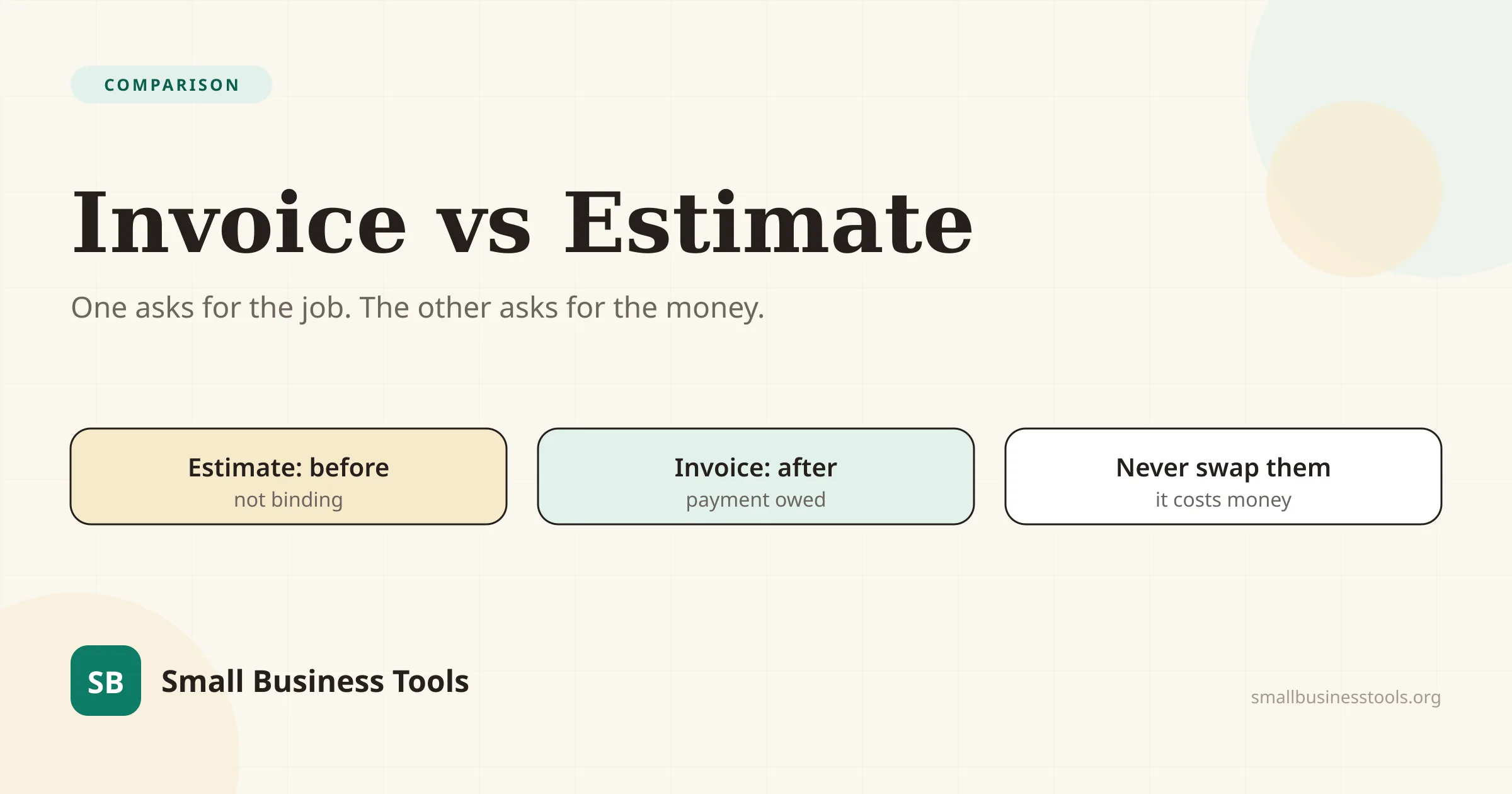
An estimate asks for the job. An invoice asks for the money. They can contain nearly identical numbers and still do opposite things — one is a proposal the client is free to decline, the other is a claim on money already earned. Confusing them is not a filing error; it costs real money, because an "invoice" sent before the work is agreed reads as presumptuous, and an "estimate" sent after the work is done gives the client permission to negotiate a price you already delivered against.
Your customers are comparing, too. The FTC advises consumers hiring for home improvement work to get multiple written estimates, each showing "a description of the work to be done, materials, completion date, and the price." If you send estimates, yours is sitting next to two others — and the one that's clearest about scope usually wins even when it isn't the cheapest.
Quick answer
| Estimate | Invoice | |
|---|---|---|
| Sent | Before the work | After the work (or at a billing milestone) |
| Purpose | Win the job, agree the scope | Get paid |
| Is it binding? | No — it's an approximation | Yes — it's a demand for payment owed |
| Contains a due date? | No, but often an expiry date | Yes, always |
| Numbers can change? | Yes, that's the point | No — changes need a credit note or revised invoice |
| Accounting status | Not recorded as income | Recorded as a receivable / income |
| Client's next step | Approve, negotiate, or decline | Pay |
The one-line version: an estimate is a forecast you're inviting the client to accept; an invoice is a record of what they now owe.
What is an estimate?
An estimate is your best good-faith calculation of what a job will cost, sent before you start. It is a sales document. Its job is to give the client enough detail to say yes — and to give you enough cover that "yes" means the same thing to both of you.
A good estimate includes:
- A scope description specific enough to show what's excluded, not just what's included.
- Line-item pricing — labor, materials, and any third-party costs, separated.
- An expiry date ("valid for 30 days"). Material prices move; without an expiry, a client can accept a six-month-old number.
- Assumptions and exclusions — the conditions your price depends on ("assumes existing subfloor is level; leveling quoted separately").
- What happens if scope changes — the sentence that prevents the most common dispute in small business work.
Critically, an estimate is *an estimate*. Because it isn't binding, the final number can move. That is also why a vague estimate is dangerous: the client remembers the number, not the caveats.
What is an invoice?
An invoice is a formal request for payment for work already delivered or a billing period already elapsed. It's an accounting document, not a sales one. Once issued it enters your books as a receivable and the client's as a payable, and both sides expect the number to be final.
An invoice adds the things an estimate deliberately lacks: a unique invoice number, an issue date, a firm due date, payment instructions, and late-payment terms. Our guide to writing an invoice covers all ten required elements and includes a copy-paste template.
Side by side: the same job, both documents
Here's a single job — a tiling contract — as it moves from proposal to payment.
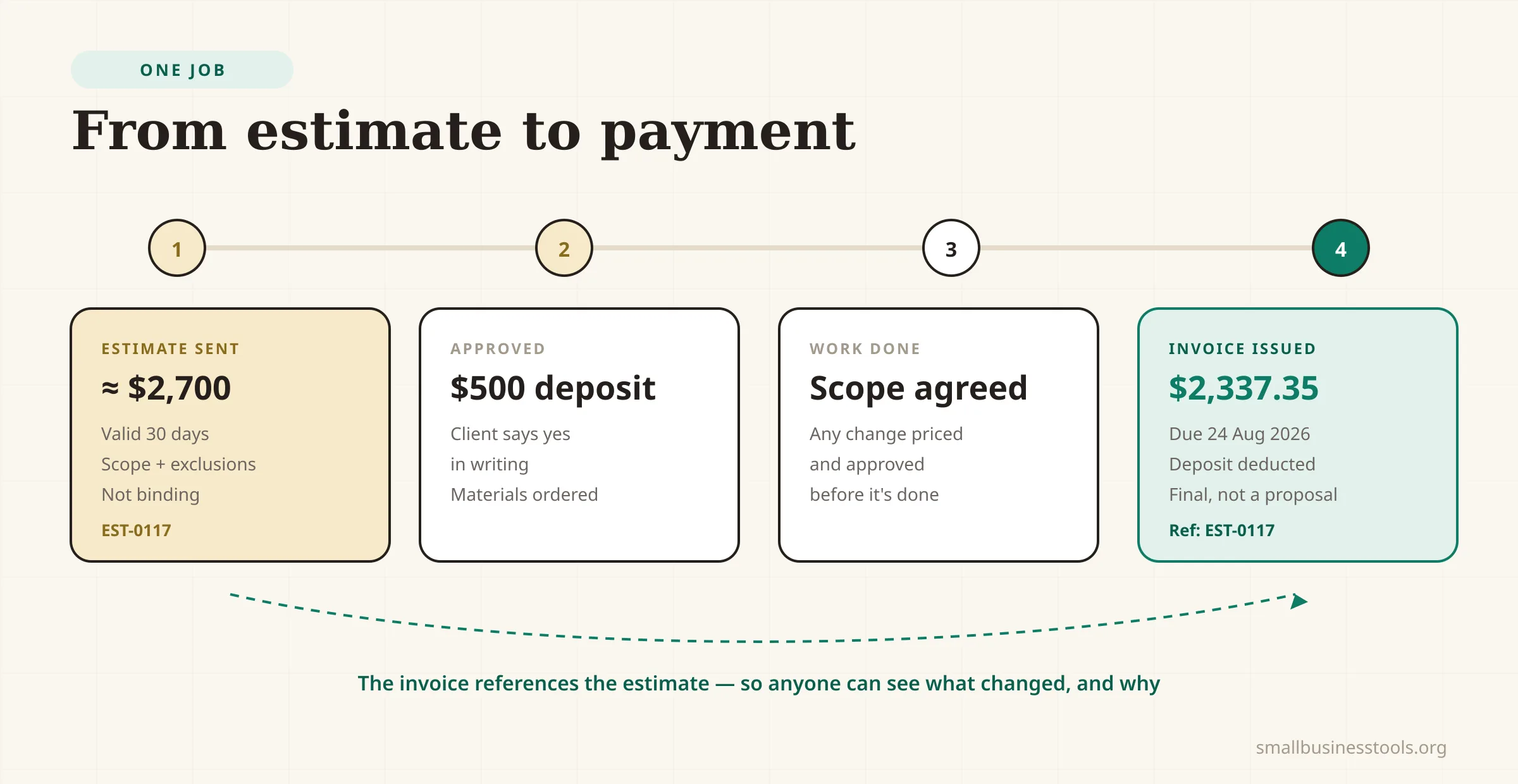
The estimate said "approximately $2,700, valid 30 days, assumes level subfloor." The invoice says "$2,337.35, due 24 August 2026, ref. estimate EST-0117, deposit of $500 applied." Same job, and the numbers even moved — legitimately, because the deposit came off and the material quantity came in under estimate. Because the invoice references the estimate, nobody has to reconstruct why.
When to send an estimate
- Any job where the price isn't fixed and published. Custom work, contracting, consulting engagements, repairs.
- Any job over a value where a surprise would be a problem. Set your own threshold and apply it consistently.
- Whenever the client is comparing suppliers. If they're getting three quotes, a clear estimate is your sales pitch.
- When scope is genuinely uncertain. An estimate lets you price ranges and state assumptions in a way an invoice can't.
The Estimate Generator builds one as a PDF in the browser — same line items and totals as an invoice, but labeled and structured as a proposal, with no signup.
When to send an invoice
- When the work is complete and accepted. Same day, ideally — payment terms only start counting from the issue date.
- At agreed milestones on longer projects (deposit, midpoint, completion).
- On a schedule for retainers or subscriptions — monthly, on the same date.
- For a deposit, before work starts. This is the one case where an invoice legitimately precedes the work, and it should reference the approved estimate.
The Invoice Generator produces the matching document, so the estimate your client approved and the invoice they pay look like they came from the same business.
Estimate vs quote vs bid vs proposal
These four get used interchangeably and shouldn't be. The distinction that matters commercially is how binding the number is.
| Document | Binding? | Typical use |
|---|---|---|
| Estimate | No — an approximation in good faith | Work where scope or materials may shift |
| Quote | Usually yes — a fixed price, if accepted in its validity window | Well-defined work you can price precisely |
| Bid | Yes — a formal, competitive offer | Tendered or contract work, often to a spec |
| Proposal | Varies — sales document that may contain a quote or estimate | Consulting and agency work where approach matters as much as price |
The practical rule: if you can define the scope precisely, quote it. If you can't, estimate it and say so. Calling a fixed price an "estimate" doesn't protect you if the client reasonably relied on it, and calling a genuine approximation a "quote" hands the client a fixed price you didn't intend to commit to.
Worked example: what happens when scope changes
A freelance designer estimates a website at 40 hours at $95/hour — $3,800, valid 30 days, assuming client-supplied copy and a maximum of two revision rounds.
The client approves. Mid-project they ask for copywriting and a third revision round. That's outside the estimate.
The wrong move: absorb it, then send an invoice for $4,600 and hope. The client sees a number 21% above what they approved and disputes it — reasonably, because they never agreed to it.
The right move: send a revised estimate or a written change order for the extra 8 hours ($760) before doing the work, get a "yes" in writing, then invoice $4,560 referencing both the original estimate and the change order.
The arithmetic is identical. The difference is whether the client agreed to the number before or after it existed. If you're setting or reviewing your rate in the first place, the Hourly Rate Calculator and our hourly rate guide work through what you need to charge to hit a target income.
Common mistakes
- Sending an invoice to win work. It reads as presumptuous and it isn't a proposal. Send an estimate.
- Sending an estimate after the job is done. You've just invited a negotiation on work you've already delivered.
- No expiry date on estimates. Costs move. A quote accepted eight months later at last year's material prices is your loss.
- No scope exclusions. "Everything not listed is included" is how the client will read it.
- Converting an estimate to an invoice without a reference. Always carry the estimate number onto the invoice — it's what makes the two reconcile.
- Doing out-of-scope work before agreeing the price. The moment to negotiate is before the work, not on the invoice.
- Using "estimate" and "quote" interchangeably in your own paperwork. Pick the one that matches how binding you intend the number to be, and use it deliberately.
- Not recording the estimate. If it isn't in your records, you can't prove what was agreed.
FAQs
Is an estimate legally binding?+
Generally no — an estimate is an approximation given in good faith, and the final amount can reasonably differ. A quote offering a fixed price for defined work is much closer to a binding offer once accepted. But this varies by state and by industry, and some states have specific rules for particular trades (auto repair and home improvement especially, where a percentage cap over the written estimate may apply). Check your state's consumer protection rules for your trade.
Can I turn an estimate into an invoice?+
Yes, and you should — it's the normal flow. Keep the line items, add an invoice number, an issue date, a firm due date, and payment instructions, then reference the original estimate number. Adjust for any deposit already paid and any agreed change orders.
How much can the final invoice differ from the estimate?+
There's no universal number, and any percentage you've heard quoted as a rule is not a federal standard. Commercially, the answer is: as much as the client agreed to in advance, and no more. Some states do cap overruns above a written estimate for specific trades. The safe practice is to get written approval for any change before doing the work.
Should I charge for producing an estimate?+
For most small jobs, no — it's a cost of sale. For complex work where the estimate itself requires real investigation (a detailed site survey, a technical audit), charging a fee that's credited against the job if they proceed is common and reasonable. State it up front.
How long should an estimate stay valid?+
30 days is the common default and works for most trades. Shorten it when material prices are volatile, lengthen it when you want to stay in a slow buying cycle. What matters is that there *is* an expiry date on the document.
Do I need to send an estimate if the client already knows the price?+
If the price is published and fixed — a standard service at a listed rate — no. For anything custom, sending one protects both sides even when the client seems certain. It's the record of what "the job" meant.
What's a change order?+
A short written document that records extra work agreed after the estimate was approved: what's being added, what it costs, and any effect on the deadline. An email that states the change and the price and gets a "yes, go ahead" reply does the job for most small businesses.
What to do next
Get the sequence right and most billing disputes disappear before they start: estimate → written approval → work → change orders in writing → invoice referencing the estimate → payment.
Generate the first document with the Estimate Generator and the last with the Invoice Generator — both run in your browser with no signup. Then decide how long the client actually has to pay: our payment terms guide covers Net 30, deposits, early-payment discounts, and late fees.
Free tools to try
Keep reading
Guide
How to Write an Invoice (With a Free Template)
How to write an invoice that gets paid: the 10 elements every invoice needs, a copy-paste template, numbering and payment terms, and a worked example.
Guide
Payment Terms for Small Business (Net 15, Net 30, Late Fees)
What Net 30 really means, how to choose payment terms, what early-payment discounts actually cost you, and how to set a late fee that holds up.
Guide
How to Set Your Hourly Rate (What to Charge)
Work out what to charge per hour: target income, real expenses, self-employment tax, and billable hours — with a formula and a full worked example.