Guide
Small Business Pricing Strategies: The Complete Guide
Price is the fastest lever a small business has. Changing it takes an afternoon, costs nothing, and flows straight to the bottom line — unlike cutting costs, which takes months, or winning customers, which takes money. It is also the lever most owners touch least, usually because the number was set once at the start and has been carried forward ever since.
Plenty of them are moving it now. In NFIB's June 2026 Small Business Economic Trends survey, a net 38% of owners reported raising average selling prices — the fourth consecutive monthly increase and the highest reading since January 2023. Raising prices is not an unusual or aggressive act. It's what most small businesses are currently doing.
This guide covers the three foundations every price sits on, the strategies built on top of them, how to choose between them for your business, and how to raise prices without losing the customers you want to keep.
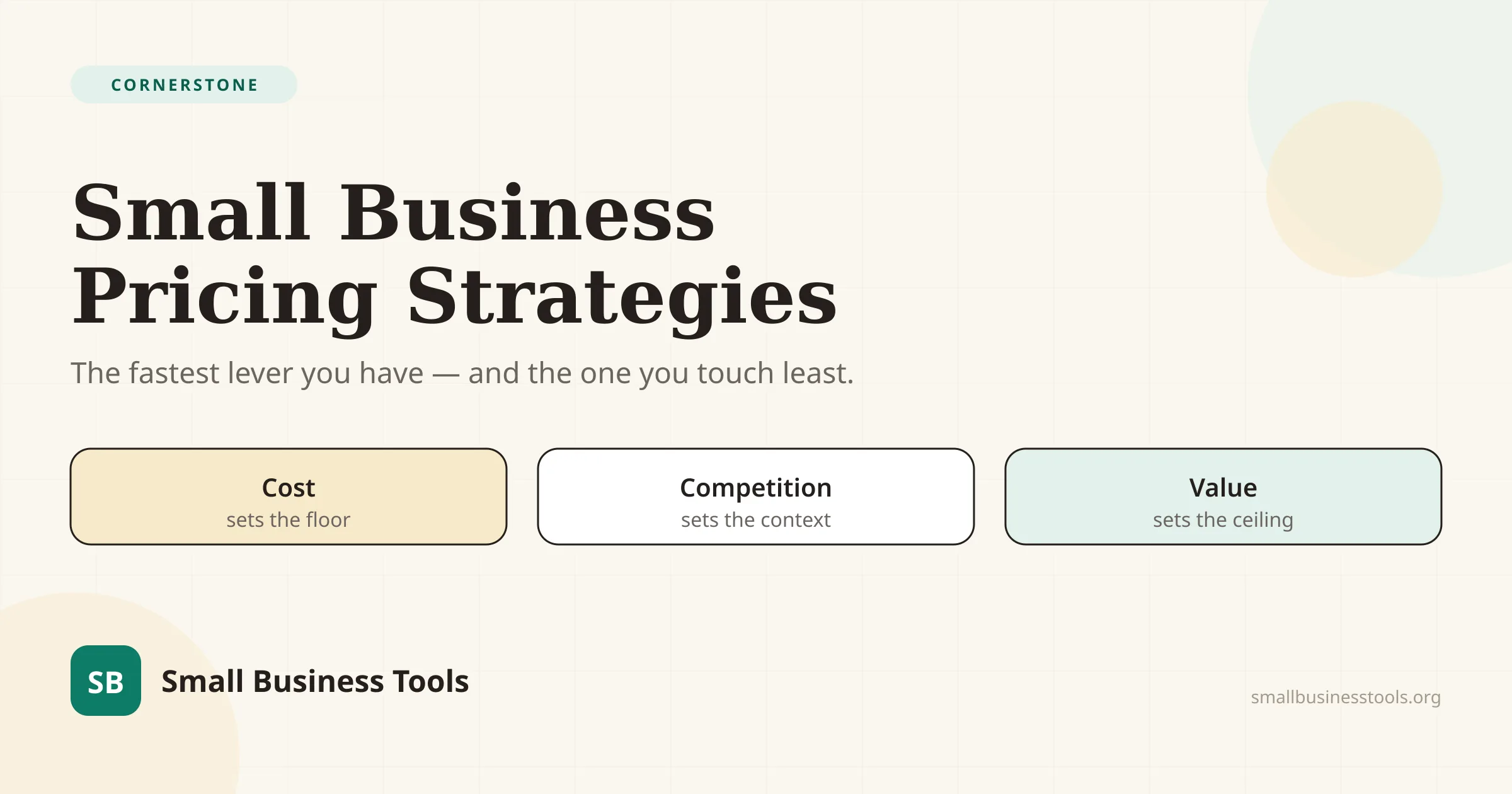
Quick answer: every price rests on one of three things
| Basis | The question it answers | Sets your |
|---|---|---|
| Cost | What does it cost me, plus what do I need to make? | Price floor |
| Competition | What do buyers currently pay for alternatives? | Price context |
| Value | What is the outcome worth to this customer? | Price ceiling |
Most small businesses use only the first, which is why most small businesses underprice. Cost tells you the lowest price you can survive at — it says nothing about the highest price you could charge. Use cost to find your floor, competition to understand the context, and value to set the actual number.
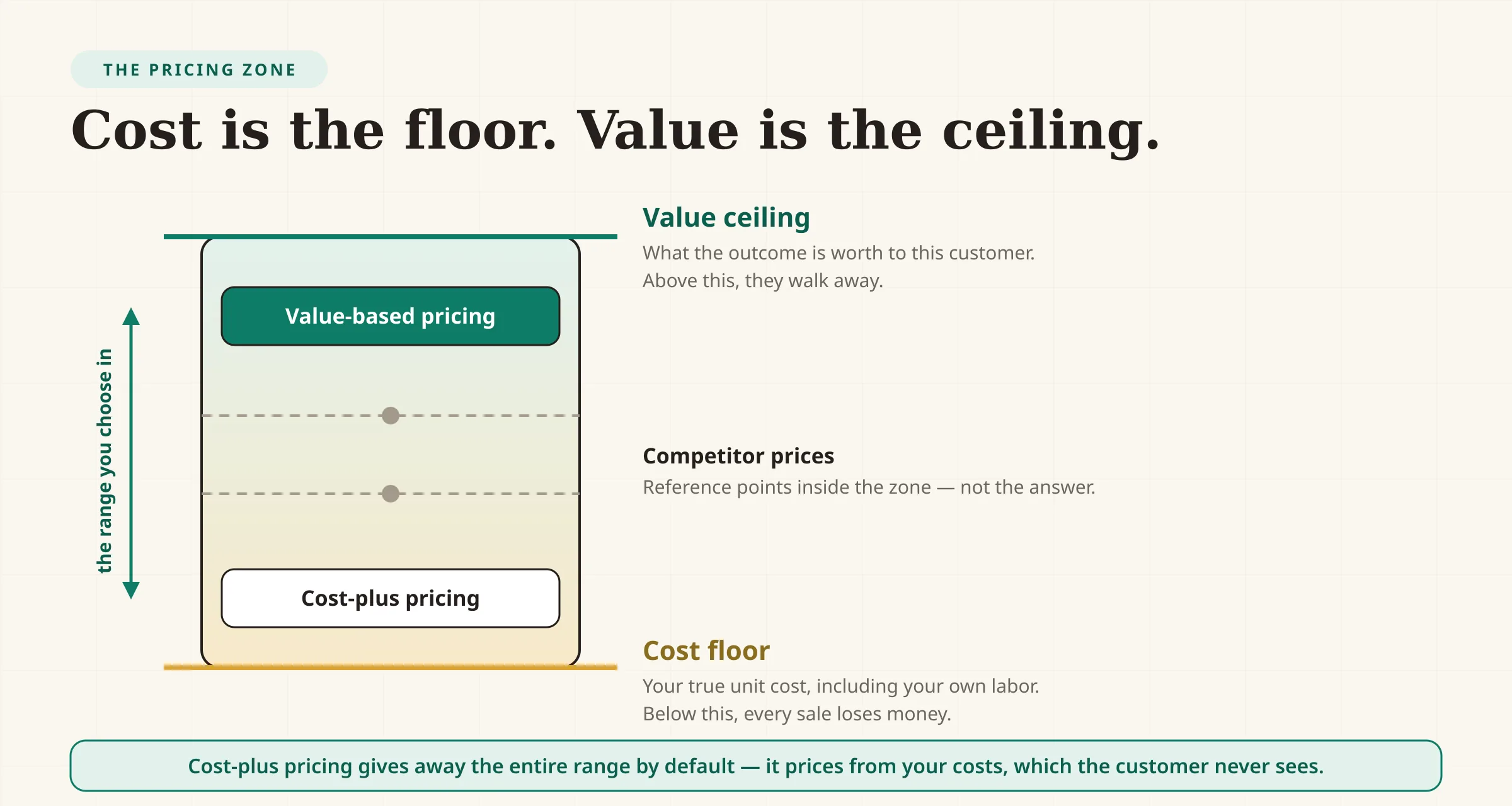
Cost-plus pricing
Add up what a unit costs you, apply a markup, and that's your price.
Those two formulas are not the same, and mixing them up is the most expensive arithmetic error in small business pricing. A 50% markup produces a 33% margin, not a 50% one. Our markup vs margin guide covers the conversion, and the Markup Calculator and Profit Margin Calculator handle each direction.
Where it works: retail and wholesale with many SKUs, trades where materials dominate, and anywhere you need a fast, consistent, defensible rule across a large catalogue.
Where it fails: it makes your price a function of your costs, which the customer does not care about. Two consequences follow. If you're efficient, you charge less — you're penalized for being good. And it caps you at your floor plus a fixed uplift, no matter how valuable the outcome.
The prerequisite most businesses skip is knowing the *true* cost. Materials are the easy part; labor, overhead, payment processing, returns, and shipping all belong in there too. Our guide on pricing a product for retail works through the full build-up.
Value-based pricing
Set the price on what the outcome is worth to the customer, not on what it costs you to produce.
A bookkeeper who saves a restaurant owner ten hours a month and catches $4,000 a year in missed deductions is delivering something worth far more than the four hours of work it takes. Cost-plus prices that at four hours. Value-based pricing prices it against the $4,000.
How to actually do it:
- Identify the outcome in the customer's terms — money made, money saved, time returned, risk removed.
- Quantify it where you can. "Recovers about 10 hours a month" is a number the customer can weigh.
- Price at a defensible fraction of that value — commonly 10–25%, so the customer's return is obvious.
- Communicate the outcome, not the inputs. Selling "a monthly bookkeeping package" invites hourly comparison; selling "books closed by the 5th, nothing missed at tax time" doesn't.
Where it works: services, consulting, B2B, anything custom, anything where results vary meaningfully by customer.
Where it's hard: you need to understand the customer's business well enough to quantify the outcome, and different customers get different value from identical work — which means either segmenting your prices or accepting an average.
For service businesses, this is usually the single largest available increase. If you're currently billing time, our hourly rate guide shows how to calculate the floor you must clear — then value pricing is how you move above it.
Competitive pricing
Set your price with reference to what alternatives cost.
This is a *reference point*, not a strategy in itself. Customers price-anchor against what they already know, so you need to know what they're comparing you to. But matching a competitor's price without knowing their costs, volumes, or business model is copying an answer to a question you weren't asked.
Three positions relative to the market:
- Below market. Only defensible with a genuine structural cost advantage. Being cheaper because you undervalue yourself isn't a strategy, it's a countdown.
- At market. Safe, and it shifts competition onto service, speed, and reputation. Fine when your differentiation is real but hard to price.
- Above market. Requires a stated reason — specialism, speed, guarantee, availability, or expertise. The reason has to be visible to the buyer before they see the price.
The trap is a price war. Someone always has more runway, and if you're small, that someone is not you.
The strategy layer
The three foundations set the level. These are the shapes you build on top.
Good-better-best (tiered pricing)
Offer three options instead of one. It changes the customer's question from "yes or no?" to "which one?" — a far easier question to say yes to.
Tiering also uses a real behavioral effect: a middle option looks reasonable next to a premium one, and a premium tier makes the middle tier the obvious sensible choice. Many businesses find the top tier sells rarely but earns its place by making the middle tier feel moderate.
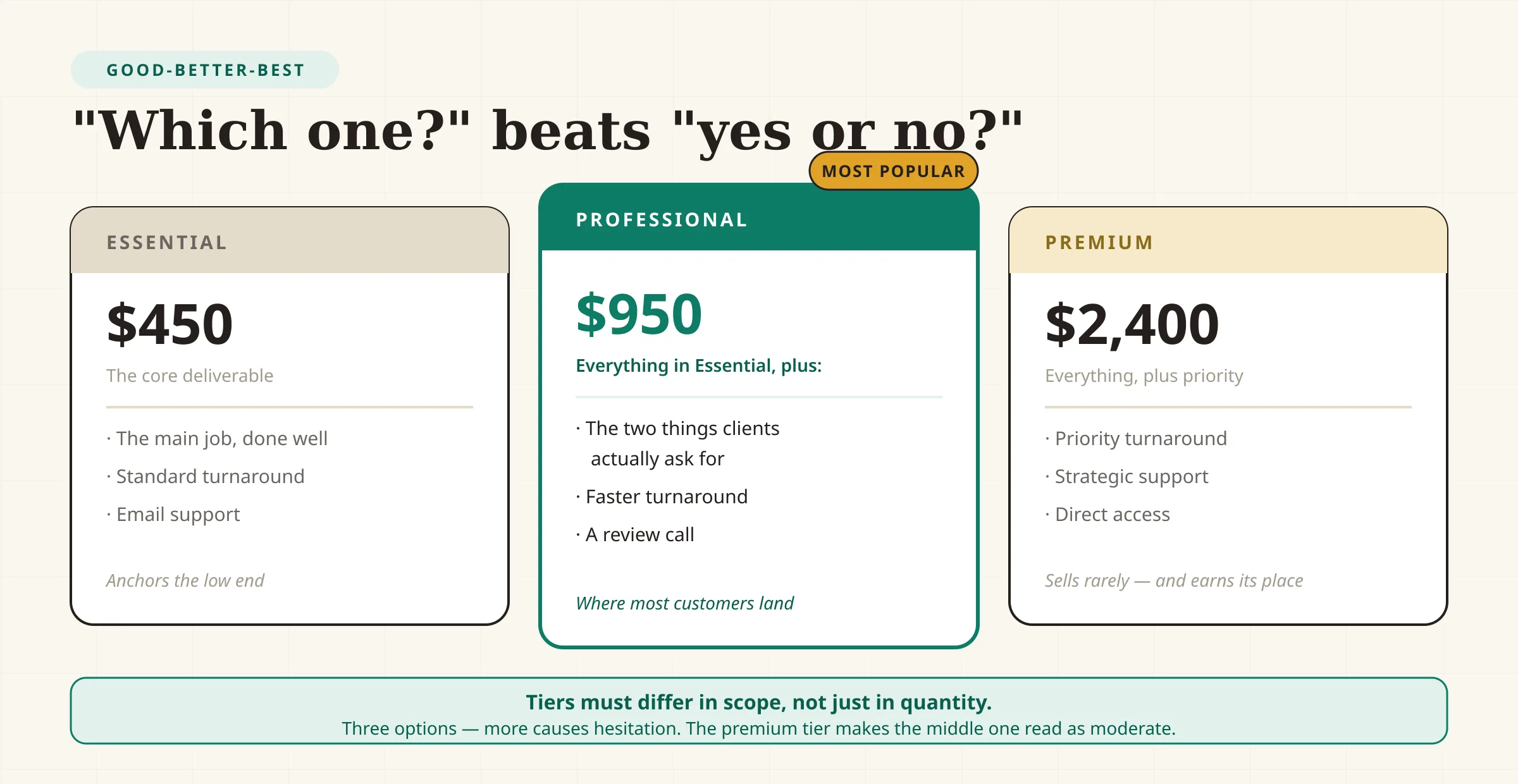
Rules that make tiering work: exactly three options (more causes hesitation), tiers that differ in scope rather than only quantity, one tier visibly marked as the common choice, and a top tier priced high enough to do its job.
Premium pricing
Deliberately pricing above the market to signal quality. Works when the buyer can't easily assess quality before purchase and uses price as a proxy — common in professional services, craft goods, and anything where a mistake is expensive.
It only works if the whole experience matches. A premium price with a weak website, slow replies, and an amateur invoice produces suspicion rather than confidence.
Penetration pricing
Launch low to win share fast, then raise. The risk is well documented in small businesses: you attract price-driven customers, and those are exactly the ones who leave when you raise. If you use it, set the end date and the target price before you launch.
Price skimming
Launch high with early adopters, then lower as the market widens. Works for genuinely novel offerings. Rarely applicable to most local and service businesses.
Bundle pricing
Sell several things together for less than their separate total. Raises average order value, moves slower-selling items, and — the real advantage — makes direct price comparison difficult. Bundle high-margin items with the item customers actually came for.
Psychological pricing
$49 rather than $50; $2,000 rather than $1,997 for premium work. Charm pricing (ending in 9) signals value; round numbers signal quality and confidence. Match the convention to your positioning rather than applying one everywhere.
Loss leaders
Price one item at or below cost to drive traffic, and earn on what customers buy alongside it. Requires that the attached purchases genuinely happen — a loss leader that customers buy alone is just a loss.
How to choose
Work through it in this order:
- Find your floor. Total your true unit cost, then your fixed costs. The Break-Even Calculator tells you the volume any candidate price must reach to cover overheads. A price that can't clear your break-even at realistic volume is not an option regardless of how attractive it looks.
- Map the context. What do buyers currently pay for the alternatives, including doing nothing?
- Estimate the ceiling. What is the outcome worth to your customer? Be concrete.
- Pick your position in that range and state the reason a buyer would accept it.
- Choose the shape. Single price, tiers, or bundles — based on how your customers actually buy.
- Test, then review on a schedule. Prices should be revisited at least annually, not when circumstances force it.
Two sanity checks worth running on any candidate price. If nobody ever objects to your price, it's too low — some resistance is evidence you're near the top of your range. And if you're consistently busy but not profitable, the problem is almost certainly price, not effort. The Profit Margin Calculator will confirm it in about a minute.
Raising prices without losing customers
The fear is universal and mostly overstated. Practical mechanics:
- Raise for new customers first. No conversation needed — it's simply your price now. You learn whether the market accepts it before you touch a single existing relationship.
- Give existing customers notice. 30–60 days, in writing, stated plainly. No apology; an apology invites negotiation.
- Don't over-explain. "Our prices are increasing on 1 October" reads as a business fact. Three paragraphs about rising costs reads as an opening offer.
- Change something visible at the same time where you can — faster turnaround, an added deliverable, better reporting. The increase lands differently when it arrives alongside a change.
- Grandfather selectively, not universally. Your best long-term customers may deserve a delay. Everyone doesn't.
- Small and regular beats large and rare. An annual adjustment is absorbed. A 40% correction after four static years is a crisis.
- Expect and accept some attrition. Losing your most price-sensitive customers at a higher price usually means more profit and fewer hours. Run the numbers before you assume a departure is a loss.
Pricing mistakes that cost the most
- Pricing from cost alone. Guarantees you capture none of the value you create.
- Confusing markup and margin. A 50% markup is a 33% margin. Get this wrong and every price in your catalogue is wrong.
- Leaving your own labor out of cost. If your time isn't in there, your "profit" is just your unpaid wage.
- Copying a competitor's price. You don't know their costs, volumes, or strategy.
- Competing on price without a cost advantage. A race you're structurally unable to win.
- Never raising prices. Your costs rose every year. A static price is a shrinking margin.
- Discounting habitually. Trains customers to wait — and it costs more than it looks. See how to calculate a discount for the volume a discount actually requires.
- One price for every customer segment. Different buyers get different value and have different alternatives.
- Changing price without measuring. Track units, revenue, *and* gross profit before and after. Revenue alone will mislead you.
The tools for each step
Every stage of this has a calculator behind it:
- True cost and floor — Break-Even Calculator for the volume any price must clear.
- Cost to price — Markup Calculator to apply an uplift, Profit Margin Calculator to hit a target margin.
- Service pricing — Hourly Rate Calculator for the floor beneath any project price.
- Promotions — Discount Calculator for the arithmetic, and how to calculate a discount for what it costs.
- Tax on top — Sales Tax Calculator, because tax is added to your price, not taken out of it.
- Return on a change — ROI Calculator to evaluate whether a pricing or marketing move paid off.
All free, all client-side, no signup. The full set is in our free small business tools hub.
FAQs
What is the best pricing strategy for a small business?+
There isn't one universal answer, but the most common improvement is moving from pure cost-plus to value-based pricing, using cost only to establish the floor. For product businesses with many SKUs, cost-plus with a deliberate target margin remains practical — the key word being deliberate.
How do I know if my prices are too low?+
Three signals: nobody ever objects to your price, you're consistently busy but not profitable, and you're meaningfully below comparable providers without a structural cost advantage. Any one of them is worth investigating; all three together is conclusive.
How often should I review my prices?+
At least annually, as a scheduled review rather than a reaction. Also review whenever your input costs move significantly, when you add real capability, or when the market shifts. Small regular adjustments are absorbed far better than large corrections.
What's the difference between markup and margin?+
Markup is profit as a percentage of cost; margin is profit as a percentage of price. The same sale gives two different percentages — a 50% markup is a 33% margin. See [markup vs margin](/guides/markup-vs-margin) for the conversion table.
Should I show my prices on my website?+
Publishing prices filters out unqualified enquiries and saves you calls, which matters when you're busy. It also makes comparison easier and raising prices more visible. A common compromise for service businesses is publishing a starting-from price or tier structure — the filtering benefit without committing to a fixed number for custom work.
How much should I raise my prices by?+
Enough to matter. A 3% increase is often absorbed by the effort of announcing it. If you're materially underpriced, a larger correction — introduced to new customers first, then existing ones with notice — is usually the right move. Base the size on the gap between your current price and your value ceiling, not on inflation.
Is it better to raise prices or cut costs?+
Raising prices, almost always, because the increase flows entirely to profit while cost cuts run into a floor and often damage the product. On a 40% margin, a 10% price rise adds far more profit than a 10% cost cut. Costs also have a limit; prices have a range.
What should I do if a customer says my price is too high?+
First, don't discount reflexively. Ask what they're comparing against — often it's a different scope. Then either restate the value in their terms, or reduce the scope to match the budget. Cutting the price while keeping the scope teaches every future customer that your price is negotiable.
What to do next
Pick one product or service today and work it through: calculate the true cost floor, estimate what the outcome is worth to the customer, and see how much of that range you're currently capturing. Most owners find they're near the bottom of it.
Start with the Profit Margin Calculator to see where you stand, use the Break-Even Calculator to confirm any new price clears your overheads, and read how to price a product for retail for the full cost build-up.
Free tools to try
Keep reading
Guide
How to Price a Product for Retail (Step by Step)
How to price a product for retail: total your true costs, pick a pricing method, and set a price that hits a real profit margin. With a worked example.
Guide
Markup vs Margin: The Difference That Costs Money
Markup vs margin explained: same numbers, different formula, very different price. See the difference with real examples and a quick conversion table.
Guide
How to Set Your Hourly Rate (What to Charge)
Work out what to charge per hour: target income, real expenses, self-employment tax, and billable hours — with a formula and a full worked example.