Guide
Payment Terms for Small Business (Net 15, Net 30, Late Fees)
Payment terms decide how long you fund your customer's business for free. That's not a rhetorical framing — it's what a receivable is. Between doing the work and getting paid, you are covering the materials, the wages, and the overhead out of your own cash.
There's a useful benchmark for what "reasonable" looks like: federal agencies are required by the Prompt Payment rule to pay vendors within 30 days of receiving a proper invoice when the contract doesn't specify otherwise, and to pay interest automatically when they're late. The Treasury sets that interest rate every six months — it's 4.75% for July through December 2026. If the federal government commits to 30 days and pays a penalty for missing it, a private client asking you for 60 is asking for a favor, not a standard.
This guide covers what the terms actually mean, how to pick them, what an early-payment discount really costs, and how to set a late fee that's enforceable rather than decorative.
Quick answer: the terms decoder
| Term | What it means | Best for |
|---|---|---|
| Due on receipt | Payment expected immediately | Retail, one-off jobs, new clients |
| Net 7 / Net 15 | Payment due 7 or 15 days after the invoice date | Freelancers, small recurring work |
| Net 30 | Payment due 30 days after the invoice date | The default for B2B work |
| Net 60 / Net 90 | 60 or 90 days | Large corporate clients — expensive for you |
| 2/10 Net 30 | 2% off if paid within 10 days, otherwise full amount at 30 | Encouraging early payment |
| 50% deposit, balance on completion | Half up front | Custom work, materials-heavy jobs |
| EOM / 15 MFI | End of month / 15th of the month following invoice | Clients running monthly payment runs |
| CIA / PIA | Cash in advance / payment in advance | New clients, high-risk work, small orders |
"Net" always counts from the invoice date, not the delivery date — which is precisely why you should invoice the day the work is accepted.
How the terms actually play out in cash
The gap between terms and reality is where small businesses get hurt. Net 30 does not mean you get paid on day 30. It means the clock *starts* when you invoice, and most late payments add to the end.
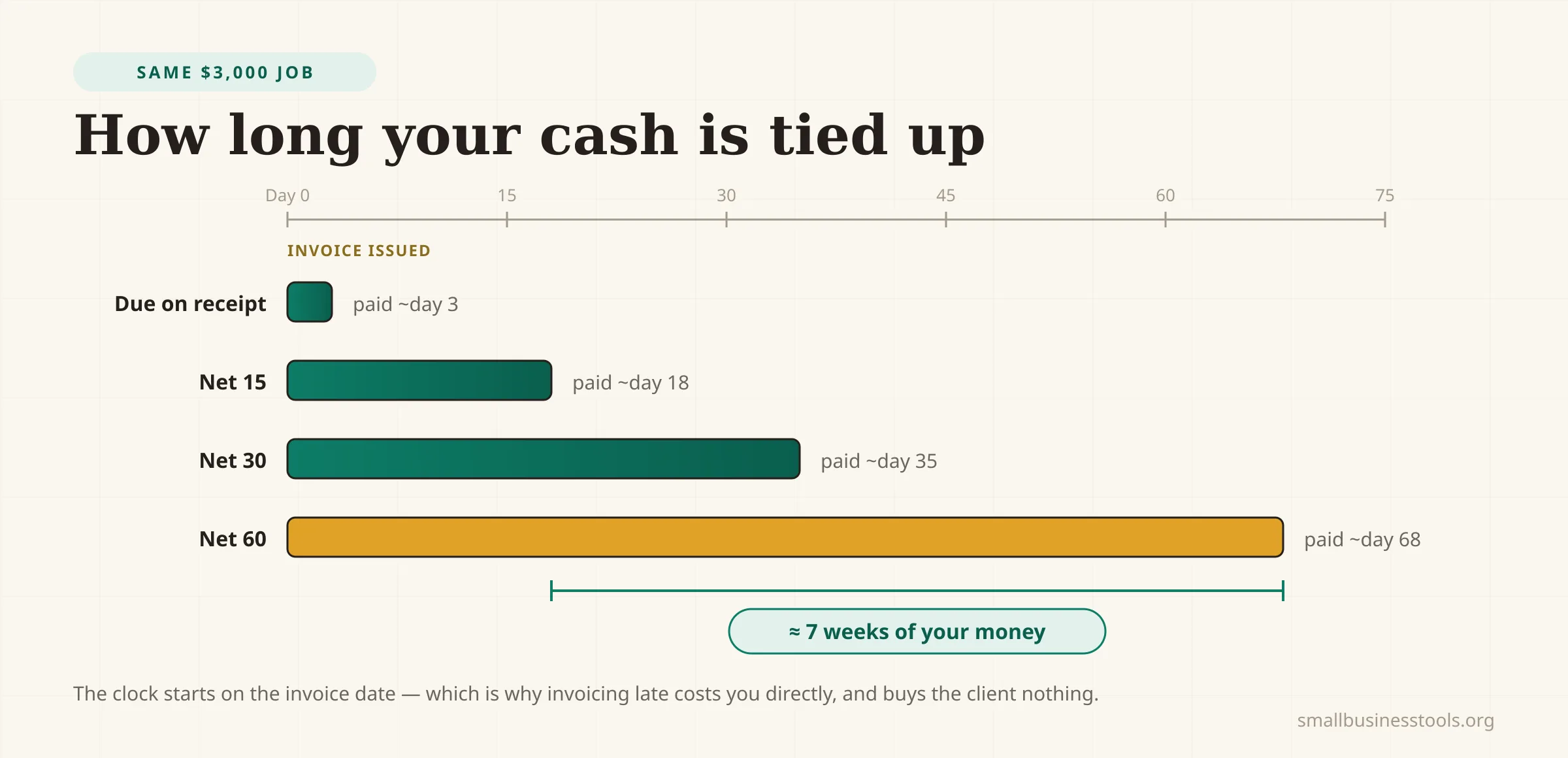
For a business invoicing $8,000 a month, moving from Net 45 to Net 15 pulls roughly a month of revenue forward — one time, permanently. That's the cheapest financing available to a small business, and it costs nothing but the decision to ask.
Choosing your terms
Work through these in order:
- Start from Net 30 as the B2B default. It's what most clients expect and won't argue with.
- Go shorter for smaller invoices and newer clients. Net 15 or due-on-receipt on a $400 invoice is entirely normal and nobody blinks.
- Take a deposit whenever you spend money before you're paid. If a job requires $1,200 of materials, you should not be carrying that. 30–50% up front is standard in the trades.
- Price longer terms in. If a client requires Net 60, that's a real cost to you. It's legitimate to reflect it in the quote — you're providing two months of credit.
- Match your own payables. If your suppliers want paying in 30 days and your customers pay in 60, you have a structural cash gap that will eventually need a credit line.
- Write terms into the contract, not just the invoice. Terms that first appear on an invoice are a request. Terms in a signed agreement are an obligation.
Early-payment discounts: what 2/10 Net 30 really costs
"2/10 Net 30" means: take 2% off if you pay within 10 days, otherwise pay in full at 30. It looks like a small concession. Run the annualized numbers and it isn't.
You're giving up 2% to get paid 20 days sooner. There are roughly 18 twenty-day periods in a year, so the annualized cost is about 2% ÷ 98% × (365 ÷ 20) ≈ 37%.
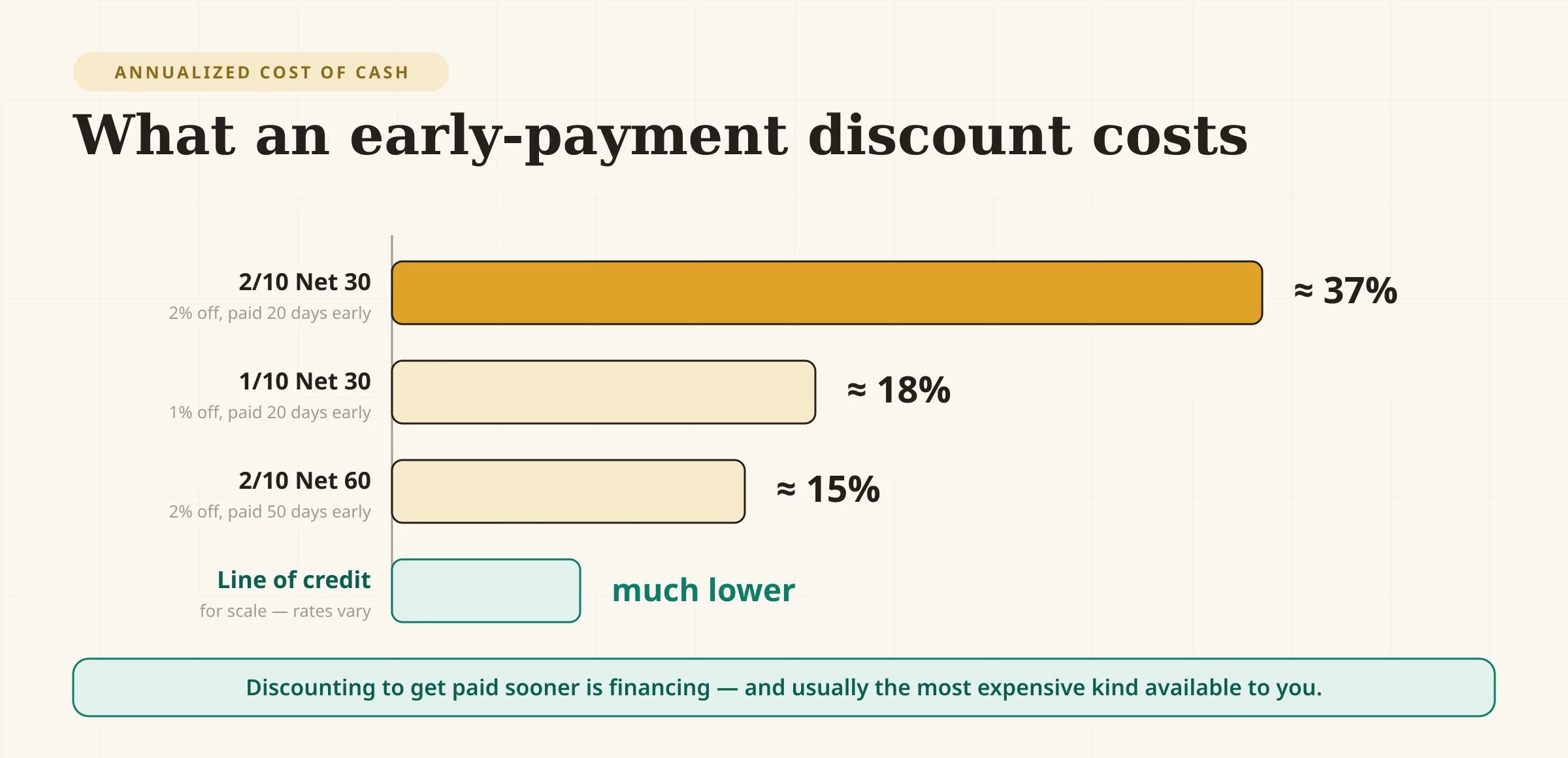
That's not automatically wrong. If you have no credit facility and a payroll run to make, 37% annualized for cash you need today can be the right call. But make it knowingly. If a bank line of credit is available at a fraction of that, borrowing is cheaper than discounting — the Loan Payment Calculator will show you what a facility actually costs per month, and the Percentage Calculator handles the discount math on a specific invoice.
The other honest reason to offer one: it changes behavior. Some clients genuinely process early-payment discounts and will move you up the queue permanently. Test it with one client before you put it on every invoice.
Deposits and milestone billing
For anything longer than a couple of weeks, terms should be a schedule rather than a single date:
- Deposit up front — covers materials and signals commitment. 30–50% is standard for custom work.
- Milestone payments — tied to deliverables, not dates ("on approval of design", not "on 15 August"). Deliverable-linked milestones are far easier to defend when a project slips for reasons on the client's side.
- Final balance on completion — with a short window, since the work is already delivered.
Milestone billing does more than smooth cash flow. It caps your exposure: if a client stops paying at milestone two, you stop at milestone two, and you're out one milestone rather than an entire project.
Late fees: setting one that works
A late fee has one job — to make paying you on time the path of least resistance. To do that it has to be announced in advance and applied consistently.
Setting it:
- State it in the contract and on every invoice, not for the first time when an invoice goes overdue. A fee the client has never seen before is difficult to enforce and reads as retaliation.
- 1–1.5% per month on the overdue balance is common practice for US small businesses.
- Check your state's cap. States regulate the maximum interest you can charge on overdue commercial balances, and rates vary considerably. A fee above your state's limit can be unenforceable — confirm the current limit for your state before setting a rate.
- Consider a flat administrative fee instead of interest for small invoices, where 1.5% of $300 isn't worth the invoice line.
Applying it: the fee only works if you actually charge it. A late fee you announce and then never apply teaches clients that your terms are advisory. Apply it on the first breach with a polite, factual note, and most clients never trigger it twice.
Getting paid faster without changing your terms
Terms are only one lever. These usually move the date more:
- Invoice immediately. The single biggest improvement available to most small businesses. The clock starts on the issue date.
- Invoice the right person. Get the accounts payable contact at the start of the engagement, not when payment is late.
- Make paying frictionless. A payment link converts far better than bank details a client has to retype — our payment processors roundup compares the real per-transaction costs.
- Reference everything. PO number, estimate number, invoice number. Missing references are a genuine and extremely common cause of stalled invoices in larger companies.
- Send a reminder before the due date, not after. A short note three days out is a courtesy, not a chase, and it catches the invoices that were simply missed.
- Confirm receipt. "Just confirming this reached the right inbox" on day one surfaces problems 29 days earlier than the alternative.
Terms you can copy
Paste this into your contract and your invoice footer, then adjust the bracketed values to your business and check the fee against your state's cap.
PAYMENT TERMS

Payment is due within [30] days of the invoice date.

A deposit of [30]% of the estimated total is payable before work
begins. The deposit is credited against the final invoice.

Invoices unpaid after the due date may incur a late fee of [1.5]%
per month on the outstanding balance, applied from the day after
the due date until payment is received.

Work on outstanding projects may be paused where an invoice remains
unpaid more than [14] days past its due date.

Accepted payment methods: [bank transfer, card, ACH].
Please quote the invoice number as the payment reference.

All prices are exclusive of applicable sales tax.
Estimates are valid for [30] days from the date of issue.
Common mistakes
- Terms with no calendar due date. "Net 30" alone leaves the arithmetic to the person least motivated to do it. Write the actual date.
- Never taking deposits. If you're buying materials before you're paid, you're lending.
- Agreeing to Net 60 without pricing it. Two months of credit is a real cost — either charge for it or don't offer it.
- Late fees that live only in the contract. Repeat them on the invoice.
- Announcing a late fee after the fact. Unenforceable in practice and it damages the relationship.
- Not checking your state's interest cap. An above-cap fee can be void.
- Discounting for early payment without doing the annualized math. 2/10 Net 30 is ~37% a year.
- Treating every client identically. Terms are a risk decision. A ten-year client and a new one shouldn't get the same exposure.
Checklist
- Standard terms chosen and written into your contract template
- Terms *and* a calendar due date on every invoice
- Deposit policy set for jobs with up-front costs
- Milestone schedule for anything over a few weeks
- Late fee stated in the contract and repeated on the invoice
- Late fee checked against your state's interest cap
- Accounts payable contact captured at the start of every engagement
- Payment link or instructions with a reference on every invoice
- Reminder scheduled a few days before the due date
FAQs
What does Net 30 mean?+
Payment is due 30 calendar days after the invoice date — not the delivery date, and not 30 business days unless you say so. Because it counts from the invoice date, delaying your invoicing directly delays your payment.
What are the most common payment terms for small businesses?+
Net 30 is the general B2B default. Freelancers and very small service businesses commonly use Net 15 or due-on-receipt, and trades work with deposits plus a balance on completion. Larger corporate clients often impose Net 60, which is why their work needs pricing differently.
Can I charge a late fee on an overdue invoice?+
Yes, provided you disclosed it in advance — in a signed contract or agreed terms — and it's within your state's limit on interest for commercial debts. Those limits vary by state, so check yours before setting a rate. A fee introduced for the first time on an already-overdue invoice is much harder to enforce.
Is 2/10 Net 30 worth offering?+
Only if you understand the price. Giving 2% to be paid 20 days early is roughly 37% annualized — usually far more than a line of credit costs. It's justifiable when you have no cheaper access to cash or when it permanently changes a client's payment behavior. It's a bad default.
Should I ask for a deposit?+
Yes, whenever you'll spend money or significant time before being paid. 30–50% up front is standard for custom and materials-heavy work. Clients who won't pay any deposit on custom work are telling you something useful about how the final invoice will go.
What can I do when a client just won't pay?+
Escalate in steps: a factual reminder, then a formal notice referencing your terms and any late fee, then pausing further work, then a formal demand letter. Small claims court is a realistic option for smaller amounts and doesn't usually require a lawyer. Prevention beats all of it — deposits, milestones, and shorter terms for clients you don't know.
Do payment terms apply to sales tax too?+
The total due on the invoice includes any sales tax, and that whole balance is subject to your terms. But your obligation to remit that tax to the state runs on the state's schedule, not your customer's — you may owe it before the customer has paid you, which is a cash-flow trap on long terms. Our [sales tax guide](/guides/how-to-calculate-sales-tax) covers how the calculation works.
What to do next
Pick your standard terms today and write them into your contract template rather than deciding invoice by invoice. Then apply the two changes that move the money soonest: invoice the same day work is accepted, and put a calendar due date on every invoice.
Generate your next invoice with those terms baked in using the Invoice Generator, and if you're still choosing how clients actually pay you, compare the real transaction costs in our payment processors roundup.
Free tools to try
Keep reading
Guide
How to Write an Invoice (With a Free Template)
How to write an invoice that gets paid: the 10 elements every invoice needs, a copy-paste template, numbering and payment terms, and a worked example.
Guide
Invoice vs Estimate: When to Use Each
Invoice vs estimate explained: what each document does, when to send which, how quotes and bids differ, and the mistakes that cost small businesses money.
Guide
Best Payment Processors for Small Business (2026)
11 payment processors compared for small businesses — real 2026 fees for Square, Stripe, PayPal, Helcim and more, plus when interchange-plus saves money.