How-to guide
How to Calculate a Discount (And What It Really Costs)
Calculating a discount takes one multiplication. Understanding what it costs you takes one more — and that second calculation is the one almost nobody runs before announcing a sale.
A 20% discount does not cost you 20%. It comes entirely out of your profit, which means on a product carrying a 40% margin, a 20% discount removes half your profit on every unit sold. To earn the same money you'd need to double your volume. Sales that "did great" on volume and quietly lost money are the normal outcome of skipping that arithmetic.
There's a legal dimension too. If you advertise a discount against a former price, the FTC's guides require that former price to be genuine — 16 CFR § 233.1 states the comparison is legitimate where the former price is "the actual, bona fide price at which the article was offered to the public on a regular basis for a reasonably substantial period of time." Inflating a "was" price to manufacture a bigger "now" saving is exactly what that rule addresses.
This guide covers both halves: the arithmetic, and the decision.
Quick answer: the formulas
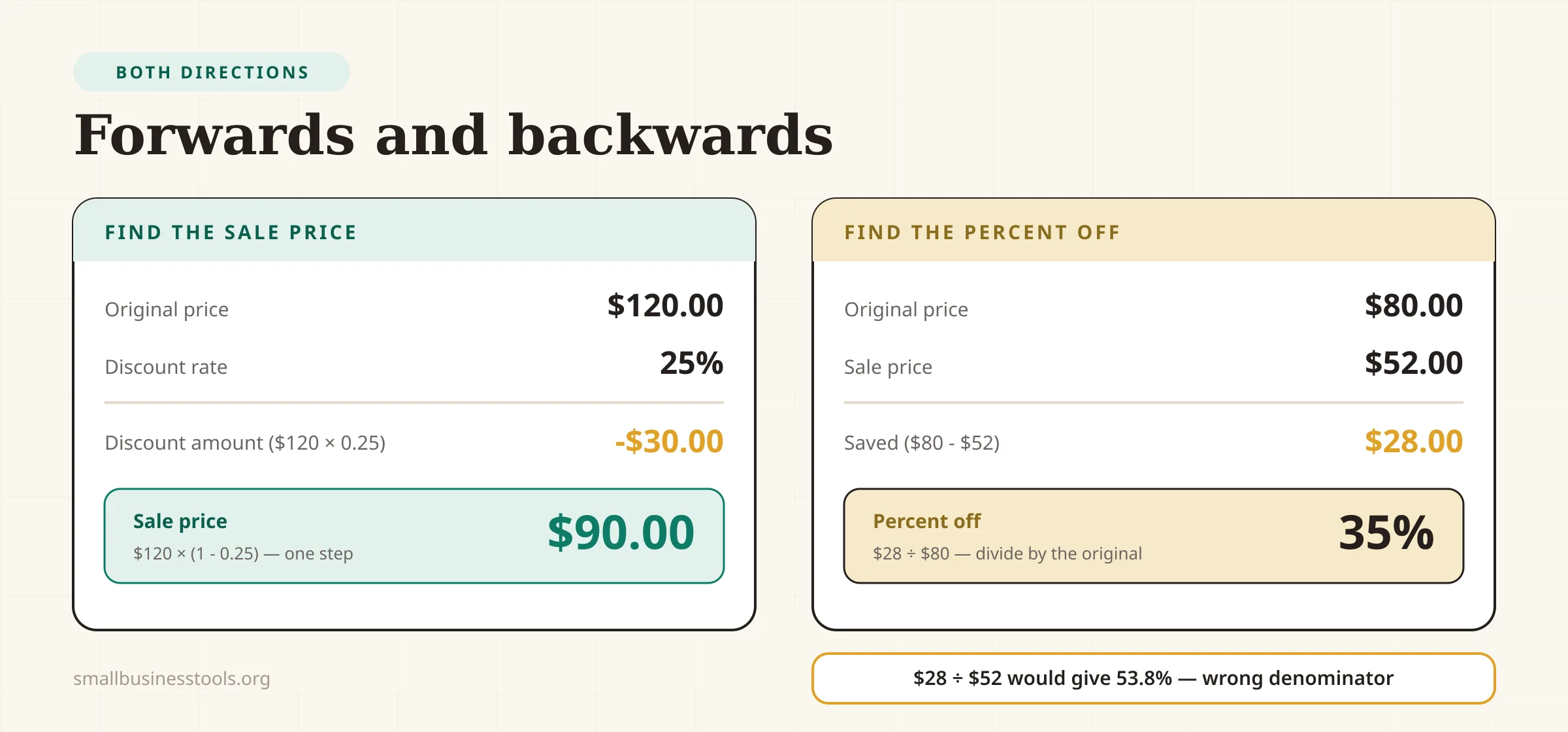
Convert the percentage to a decimal first: 25% is 0.25.
On a $120 item at 25% off: the discount is 120 × 0.25 = $30, and the sale price is 120 × 0.75 = $90. The second formula gets you there in one step, which is why it's the one worth remembering. The Discount Calculator does all three directions instantly.
How to calculate a discount, step by step
- Convert the rate to a decimal. Divide by 100 — 25% becomes 0.25.
- Multiply the original price by the rate for the amount saved.
$120 × 0.25 = $30. - Subtract from the original for the sale price.
$120 − $30 = $90.
Or in one step: multiply by 1 − rate. $120 × 0.75 = $90.
Working backwards: what percent off is this?
When you know both prices and want the percentage — useful for checking a supplier's claim, or working out what you actually gave away:
An item marked down from $80 to $52: (80 − 52) ÷ 80 × 100 = 35% off.
Note the denominator is the original price. Dividing by the sale price instead is a common slip and inflates the number — 28 ÷ 52 would give 53.8%, which is wrong. The Percentage Calculator handles this and the reverse.
Stacked discounts don't add up
"Take an extra 20% off sale items already reduced by 30%" is not 50% off. Percentages apply in sequence, each to a smaller base.
On a $200 item:
- 30% off:
200 × 0.70 = $140 - A further 20% off that:
140 × 0.80 = $112
$112 is 44% off the original, not 50%. The shortcut is to multiply the remainders: 0.70 × 0.80 = 0.56, so the customer pays 56% of the original — a 44% discount.
This matters in both directions. Customers who expect 50% and are charged $112 feel misled, and businesses that advertise "50% off in total" when the mechanic delivers 44% have a claim they can't support. State the actual final price.
What a discount actually costs you
The whole discount comes out of your profit, because your costs don't move when your price does. This is the calculation to run before announcing a sale.
Take a product that sells for $100 and costs you $60 — a 40% margin, $40 of profit per unit.
| Discount | New price | Profit per unit | Profit lost | Extra volume needed to break even |
|---|---|---|---|---|
| 0% | $100 | $40 | — | — |
| 5% | $95 | $35 | 12.5% | +14% |
| 10% | $90 | $30 | 25% | +33% |
| 20% | $80 | $20 | 50% | +100% |
| 30% | $70 | $10 | 75% | +300% |
| 40% | $60 | $0 | 100% | impossible |
At a 40% margin, a 40% discount sells at cost. Every unit you move at that price contributes nothing — you're doing the work for free, and paying the payment processing fees on top.
The general rule:
Both figures as percentages of the selling price. At a 40% margin with a 20% discount: 40 ÷ (40 − 20) = 2.0 — you need to sell twice as many units to make the same gross profit.
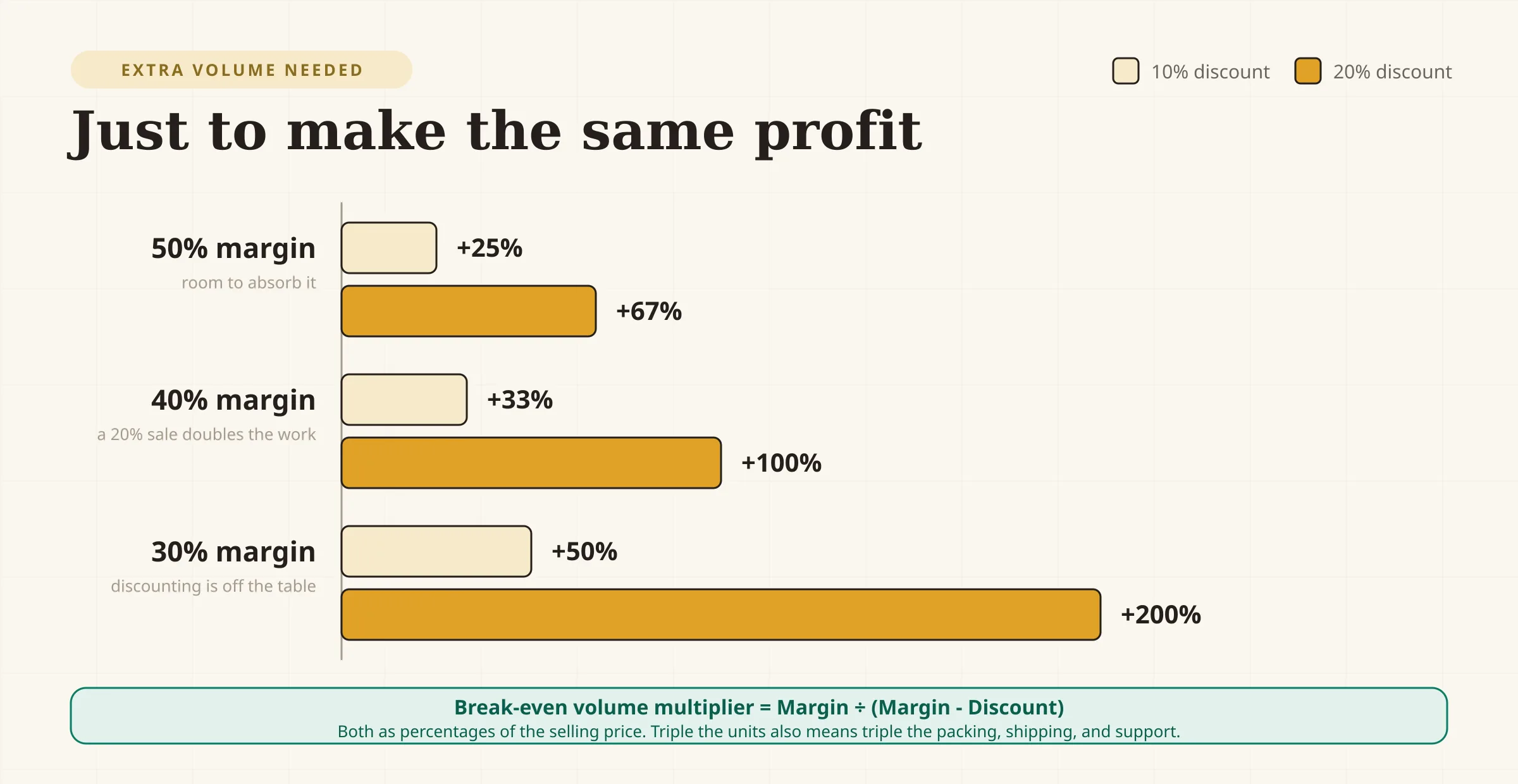
The lesson embedded in that chart: low-margin businesses cannot afford to compete on discounts. If your margin is 30%, a 20% sale needs three times the units to hold profit flat — and three times the units means three times the packing, shipping, and support. Check your actual margin with the Profit Margin Calculator before you decide a discount is affordable.
Worked example: the sale that lost money
A homeware shop runs a 25% weekend sale. Normal week: 120 units at $45, costing $27 each.
Normal week: 120 × ($45 − $27) = $2,160 gross profit.
Sale weekend: price drops to $45 × 0.75 = $33.75, so profit per unit falls to $33.75 − $27 = $6.75. Volume jumps 80% to 216 units.
216 × $6.75 = $1,458 gross profit.
An 80% sales increase produced 32% *less* profit. To merely match the normal week the shop needed $2,160 ÷ $6.75 = 320 units — a 167% increase, which matches the formula: the starting margin was 40%, so 40 ÷ (40 − 25) = 2.67.
The sale was a success by every metric on the till and a failure on the only one that pays the rent.
When discounting is the right call
Discounting isn't always wrong — it's wrong when it's unconsidered. Legitimate uses:
- Clearing dead stock. Inventory that isn't selling is already a loss; recovering cash beats holding it.
- Buying a first purchase where you know the repeat rate. A discount that costs $12 to acquire a customer worth $300 over two years is marketing spend, not lost margin.
- Rewarding volume. A genuine trade discount for larger orders reflects real economies in your cost to serve.
- Accelerating cash. Early-payment discounts trade margin for speed — see our payment terms guide for what those actually cost annualized.
- Filling capacity that would otherwise be idle. A quiet Tuesday at a discount beats an empty one, provided it doesn't cannibalize your full-price Saturday.
The common thread: each has a defined purpose beyond "sales are slow." Habitual discounting trains customers to wait for the next sale, which permanently lowers your effective price without ever appearing as a price cut.
Advertising a discount honestly
If you advertise a saving against a former price, that former price has to be real. The FTC's guides against deceptive pricing describe a legitimate comparison as one where the former price was actually offered "openly and actively" for a reasonably substantial period in the regular course of business. Practical implications:
- Don't set an inflated "regular" price you never genuinely sold at just to advertise a discount from it.
- Don't run a "limited time" sale that never ends — a permanent discount is your real price.
- If you compare against a manufacturer's list price, make sure that price is actually representative of what the item sells for.
- Say what the final price is when discounts stack, rather than advertising the two percentages added together.
Common mistakes
- Adding stacked percentages. 30% then 20% is 44%, not 50%.
- Dividing by the sale price when working backwards. Always divide by the original.
- Assuming a discount costs its percentage. It costs a share of your *profit*, which is always larger.
- Discounting without knowing your margin. You can't judge affordability without the starting number.
- Judging a sale on revenue. Revenue always rises in a sale. Gross profit is the test.
- Discounting low-margin products. The volume required is usually unreachable.
- Running permanent "sales." Trains customers to never pay full price.
- Inflating a former price to advertise a bigger saving. That's exactly what the FTC guides address.
Checklist
- Rate converted to a decimal before multiplying
- Sale price calculated as original × (1 − rate)
- Stacked discounts multiplied in sequence, never added
- Current margin known before deciding the discount
- Break-even volume multiplier calculated
- Judged on gross profit, not revenue
- Discount has a defined purpose and an end date
- Any advertised "was" price is one you genuinely sold at
FAQs
How do I calculate a 20% discount?+
Multiply the price by 0.20 for the amount off, or by 0.80 for the sale price directly. On $150: `150 × 0.20 = $30` off, giving `150 × 0.80 = $120`.
How do I work out what percentage discount was given?+
Subtract the sale price from the original, divide by the **original**, and multiply by 100. From $80 to $52: `(80 − 52) ÷ 80 × 100 = 35%`.
Do stacked discounts add together?+
No. They apply in sequence to a shrinking base. 30% then 20% leaves the customer paying `0.70 × 0.80 = 56%` of the original — a 44% total discount, not 50%.
How much does a discount cost my profit?+
The full discount comes out of profit. Divide your starting margin by (margin − discount) to get the volume multiple you'd need to break even. At a 40% margin, a 20% discount needs double the units.
What discount can I afford to offer?+
It depends entirely on your margin and whether the extra volume is realistic. At a 50% margin a 10% discount needs 25% more volume, which is often achievable. At a 30% margin the same discount needs 50% more, which usually isn't. Calculate the multiplier first.
Is it better to discount or to add value?+
Adding value is almost always better for margin. A bonus item that costs you $8 but is worth $25 to the customer is a far cheaper way to close a sale than $25 off the price, because you give up cost rather than pure profit — and it doesn't reset the customer's expectation of what your product costs.
Can I advertise any price as the "regular" price?+
No. Under the FTC's guides, a former-price comparison is legitimate only where that price was genuinely and actively offered for a reasonably substantial period. A "regular" price that exists only to make the sale price look better is the practice the rule targets.
What to do next
Before your next promotion, run two numbers: your current margin, and the break-even volume multiplier for the discount you're considering. If the volume it needs isn't realistic, the discount isn't affordable — and adding value, or a smaller discount on a tighter selection, will do more for you.
Use the Discount Calculator for the arithmetic, the Profit Margin Calculator for the starting margin, and read markup vs margin if the two percentages still feel interchangeable — that confusion is what makes discounts look more affordable than they are.
Free tools to try
Discount Calculator
Calculate sale price after discount or find the discount percentage from original and final price.
Profit Margin Calculator
Find your margin, markup, and profit from cost and revenue — instantly.
Percentage Calculator
What is X% of Y, X is what % of Y, and percent change — answered in plain words.
Keep reading
Guide
Markup vs Margin: The Difference That Costs Money
Markup vs margin explained: same numbers, different formula, very different price. See the difference with real examples and a quick conversion table.
Guide
Small Business Pricing Strategies: The Complete Guide
The pricing strategies that work for small businesses — cost-plus, value-based, tiered, and premium — how to choose one, and how to raise prices without losing customers.
Guide
How to Calculate Profit Margin (Formula + Examples)
How to calculate profit margin step by step — the formula, the difference between gross, operating, and net margin, and worked examples with real numbers.