Guide
Most Profitable Small Business Niches (And the Math Behind Them)
"Most profitable" and "highest revenue" are not the same thing, and confusing them is how small business owners end up busy and broke. A business that bills $500,000 a year but keeps 6% of it makes less money than one that bills $180,000 and keeps 40%. For a solopreneur, margin is the number that matters — because you are the labor, the overhead, and the profit all at once. Margins differ enormously by industry, not just by effort — NYU Stern's widely-cited margins-by-sector data shows net margins ranging from low single digits in some sectors to well over 20% in others.
This guide ranks the most profitable small business niches by the thing that actually determines your take-home: profit margin. Then it shows you how to check the profitability of any niche yourself, so you're not trusting a list — including this one — on faith.
Why margin beats revenue for small businesses
Profit margin is the percentage of each dollar of revenue you keep after costs. A high-revenue, low-margin business needs volume, staff, and systems to net real money — which is the opposite of a lean solopreneur setup. A high-margin business can be small and still pay you well.
Two quick examples with real numbers:
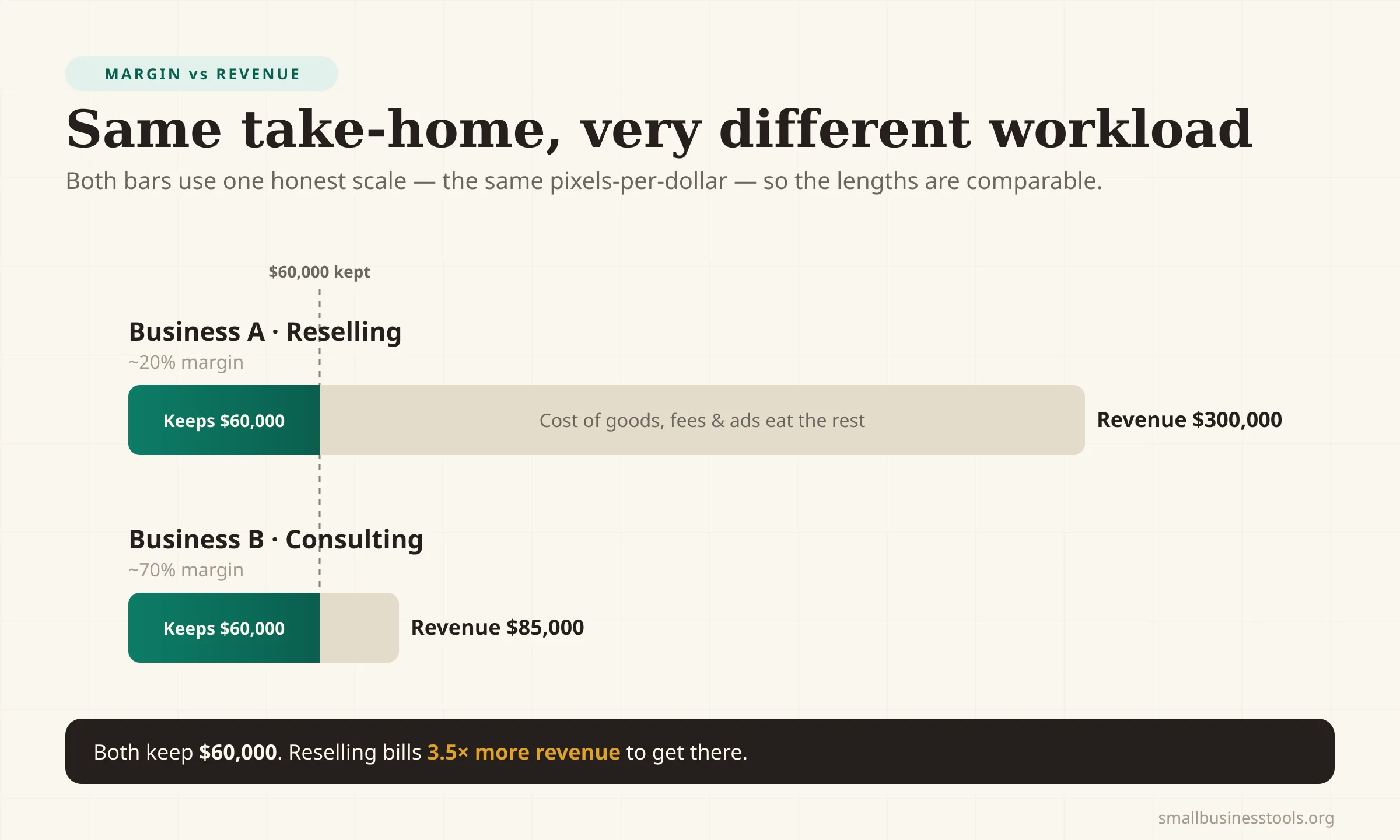
- A reselling business buys inventory for $80 and sells it for $100. That's a 20% gross margin — before rent, fees, and returns. To clear $60,000 a year in gross profit, it must sell $300,000 of product.
- A consulting business sells $100 of advice that cost almost nothing to produce but the consultant's time. Margin can exceed 70%. The same $60,000 gross needs roughly $85,000 in revenue, not $300,000.
Same take-home, wildly different amount of work and risk. Run any idea through the Profit Margin Calculator before you fall for a big revenue number — it converts "sounds impressive" into "here's what you actually keep."
The highest-margin small business niches
Ranked roughly from highest to lowest typical margin. These are patterns, not guarantees — your execution moves the number more than the category does.
| Niche | Typical gross margin | Why it's high | Startup cost |
|---|---|---|---|
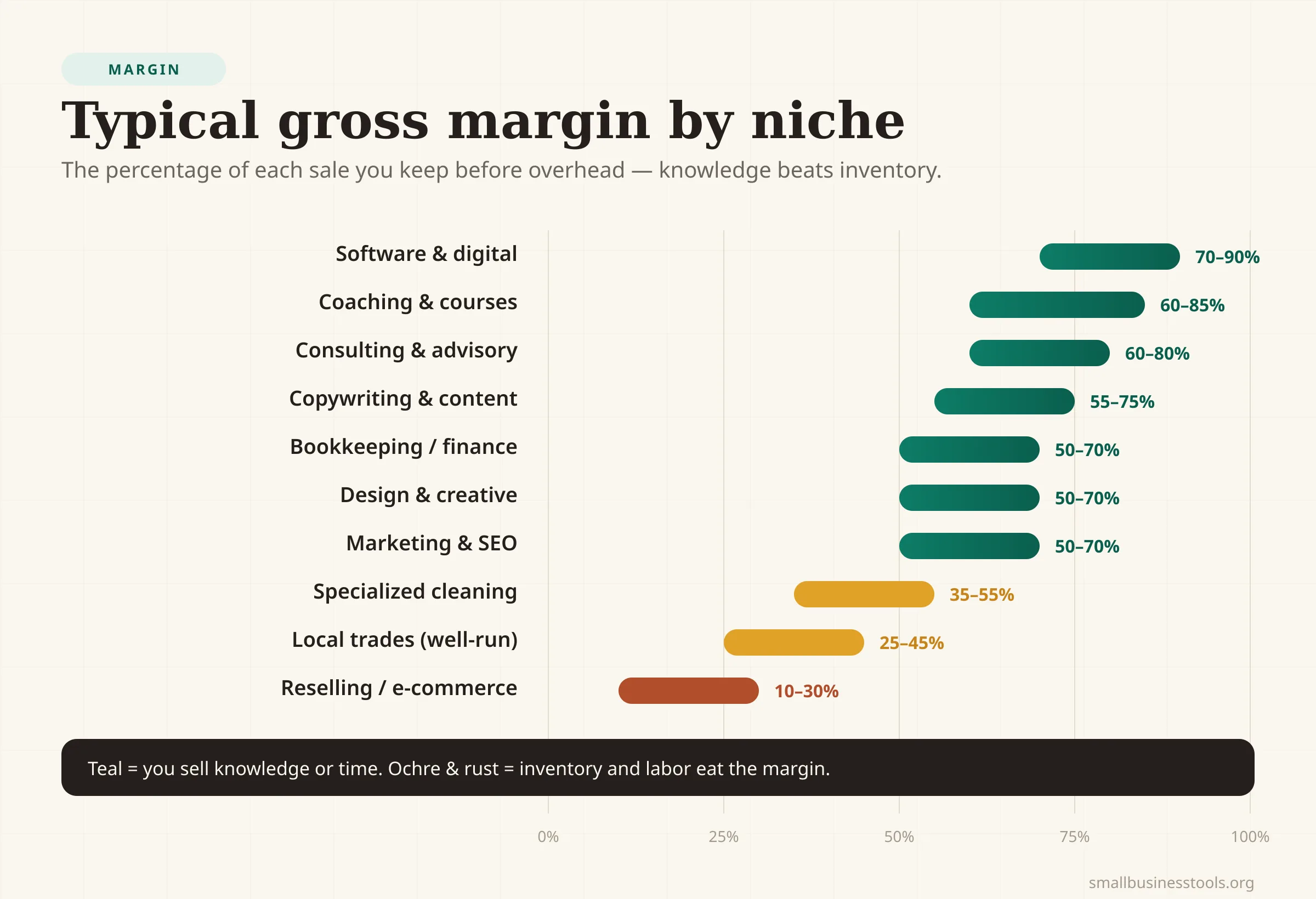
| Consulting & advisory | 60–80% | You sell expertise, not materials | Low |
| Coaching & courses | 60–85% | Build once, sell many (courses); pure time (coaching) | Low–medium |
| Bookkeeping & fractional finance | 50–70% | Recurring, software-light, high trust | Low |
| Software & digital products | 70–90% | Near-zero marginal cost per sale | Medium–high |
| Copywriting & content services | 55–75% | Skill-based, no inventory | Very low |
| Design & creative services | 50–70% | Skill-based, repeat and retainer potential | Low |
| Marketing & SEO services | 50–70% | Recurring retainers, low materials | Low |
| Specialized cleaning (post-construction, medical) | 35–55% | Premium pricing, low material cost | Low–medium |
| Local trades (well-run) | 25–45% | Labor-heavy but strong repeat demand | Medium |
| Product reselling / e-commerce | 10–30% | Inventory and platform fees eat margin | Medium–high |
The top of this table shares a trait: you sell knowledge or time, not stuff. No inventory, no cost of goods, no warehouse. That is why service and digital niches dominate the profitability rankings for small operators — and why "start a store" is one of the hardest, thinnest-margin ways to begin.
What actually drives the margin
The niche sets the ceiling; these four levers decide where you land inside it:
- Recurring revenue. A $400/month retainer that renews beats a $1,200 one-off, because you're not paying to re-acquire the customer every time. Recurring niches (bookkeeping, marketing, coaching) compound.
- Pricing power. Specialists charge more than generalists. "Bookkeeping for dental practices" commands a premium "general bookkeeping" never will. Narrowing the niche directly raises the margin.
- Delivery cost. Every hour you spend delivering is an hour you can't sell twice. Productizing and systematizing delivery is how service businesses push margin toward digital-product levels.
- Customer acquisition cost. If it costs you $600 of ads and time to land a client worth $800, your "high-margin" service isn't. Track this — the ROI Calculator turns acquisition spend and customer value into a real return number.
How to check a niche's profitability yourself
Don't trust a list. Run the four-step check on any niche you're considering:
- Estimate revenue per customer. What can one customer realistically pay you, per sale or per month?
- Estimate cost to deliver. Your time (priced at a real rate), materials, software, and fees. Time is a cost even when no cash leaves your account.
- Calculate the margin. Revenue minus delivery cost, as a percentage. Do it fast on the Profit Margin Calculator. Under ~30% for a solo service business, the numbers get tight once life happens.
- Factor in acquisition and lifetime. How much to get one customer, and how long do they stay? A 70% margin with a customer who churns in one month can lose to a 40% margin with a customer who stays two years. The ROI Calculator closes this loop.
If you're still choosing between niches, the Business Niche Finder can generate specific candidates to run through this exact check — and our untapped niches guide covers how to find profitable gaps competitors are ignoring.
Worked example: two niches, same effort
Say you can commit 20 billable hours a week.
- Niche A — general virtual assistant at $30/hour. 20 hours = $600/week, roughly $2,600/month. Margin is high (it's your time), but the *price* is low because it's a commodity.
- Niche B — email marketing for e-commerce brands at $90/hour, sold as a $2,000/month retainer per client. Two clients = $4,000/month for the same 20 hours, plus recurring revenue you don't have to re-sell each month.
Same hours, same person, nearly double the income — because Niche B is specialized, priced on value, and recurring. That is the whole game: profitability comes from the combination of a good niche and the four levers above, not from the niche label alone.
Common mistakes chasing profit
- Optimizing for revenue. A big top-line number with a thin margin is a treadmill. Keep-rate beats headline revenue every time for a small operator.
- Forgetting your own time is a cost. "It only cost me $50 in materials" ignores the 12 hours you spent. Price your time in, always — the Hourly Rate Calculator shows the rate you actually need.
- Racing to the bottom on price. Cutting price to win work destroys the margin that made the niche attractive. Compete on specialization and outcomes, not on being cheapest.
- Ignoring churn. High margin means nothing if customers leave in a month. Recurring, sticky niches quietly out-earn flashier ones.
FAQs
What is the most profitable small business to start?+
For a solopreneur, knowledge and service businesses — consulting, coaching, bookkeeping, copywriting, marketing — top the list because they carry no inventory and sell expertise at 50–80% margins. Digital products can be even higher but take longer to reach the first sale.
What's a good profit margin for a small business?+
It varies by model, but for a solo service business you generally want gross margins above 30–40% after your own time is counted as a cost. Product and reselling businesses run thinner (10–30%) and need volume to make up for it. Check any specific case on the [Profit Margin Calculator](/tools/profit-margin-calculator).
Are high-revenue businesses more profitable?+
Not necessarily. Revenue is what you bill; profit is what you keep. A lean, high-margin service business can out-earn a high-revenue business that keeps only single-digit percentages after costs and staff.
Why is reselling / e-commerce lower on the list?+
Inventory, shipping, returns, and platform fees eat into every sale, pushing margins to 10–30%. It can still be a great business, but it needs volume and working capital — a harder starting point than a service you can sell with just your skill.
How do I raise the margin in a niche?+
Specialize to raise pricing power, add recurring revenue, productize delivery to cut the cost of each sale, and lower customer acquisition cost. These four levers move your margin more than switching niches does.
Final take
The most profitable small business niches for a solo operator are the ones that sell expertise or time — consulting, coaching, bookkeeping, and specialized services — because they skip inventory and command real pricing power. But the category only sets the ceiling; recurring revenue, specialization, lean delivery, and cheap acquisition decide where you actually land. Run every idea through the Profit Margin Calculator and ROI Calculator before you commit, and let the math — not the hype — pick your niche.
Free tools to try
Profit Margin Calculator
Find your margin, markup, and profit from cost and revenue — instantly.
ROI Calculator
See your return on investment as a percentage — plus annualized ROI over time.
Business Niche Finder
5 specific niches matched to your skills — with the first offer and a cheap way to validate each.
Keep reading
Guide
Best Small Business Ideas for Solopreneurs in 2026
27 realistic small business ideas for solopreneurs, sorted by startup cost and how fast you can land the first paying customer. No fluff, no get-rich-quick.
Guide
Untapped Small Business Niches: 18 Underserved Markets
18 untapped small business niches where demand outruns supply. How to spot an underserved market, validate it in a week, and own it before competitors notice.