Guide
Best Small Business Ideas for Solopreneurs in 2026
The best small business idea for a solopreneur is not the one with the biggest market — it is the one you can start this month, sell for real money by next month, and run without hiring anyone. That rules out most of the "passive income" ideas you see on social media and leaves a much shorter, much more honest list. There's real room for it: the U.S. Small Business Administration's Office of Advocacy counts more than 33 million small businesses in the country, most of them solo operations with no employees.
This guide is that list: 27 solopreneur business ideas grouped by how much cash it takes to start and how quickly you can reasonably get to your first paying customer. Every idea here can be run by one person, most from a laptop or a van, and none of them require outside funding.
How to judge a small business idea
Before the list, three filters worth applying to any idea — yours or one below:
- Time to first dollar. How many days from "I decided to do this" to "someone paid me"? Service businesses win here: you can sell a bookkeeping cleanup or a logo before you have a website. Product and audience businesses are slower.
- Startup cost you can lose. Never bet money you need. The strongest solopreneur ideas start under $500 because the main input is your existing skill, not inventory or equipment.
- Repeatability. A one-off $2,000 project is nice. A $400/month retainer that renews for two years is a business. Favor ideas with recurring revenue or repeat purchase built in.
If you are staring at a blank page, the Business Ideas Generator will give you a starting shortlist based on your skills and interests, and the Business Niche Finder will narrow a broad idea into a specific, sellable niche. Use them to break the blank-page problem, then pressure-test whatever comes out against the three filters above.
Service businesses you can start this week
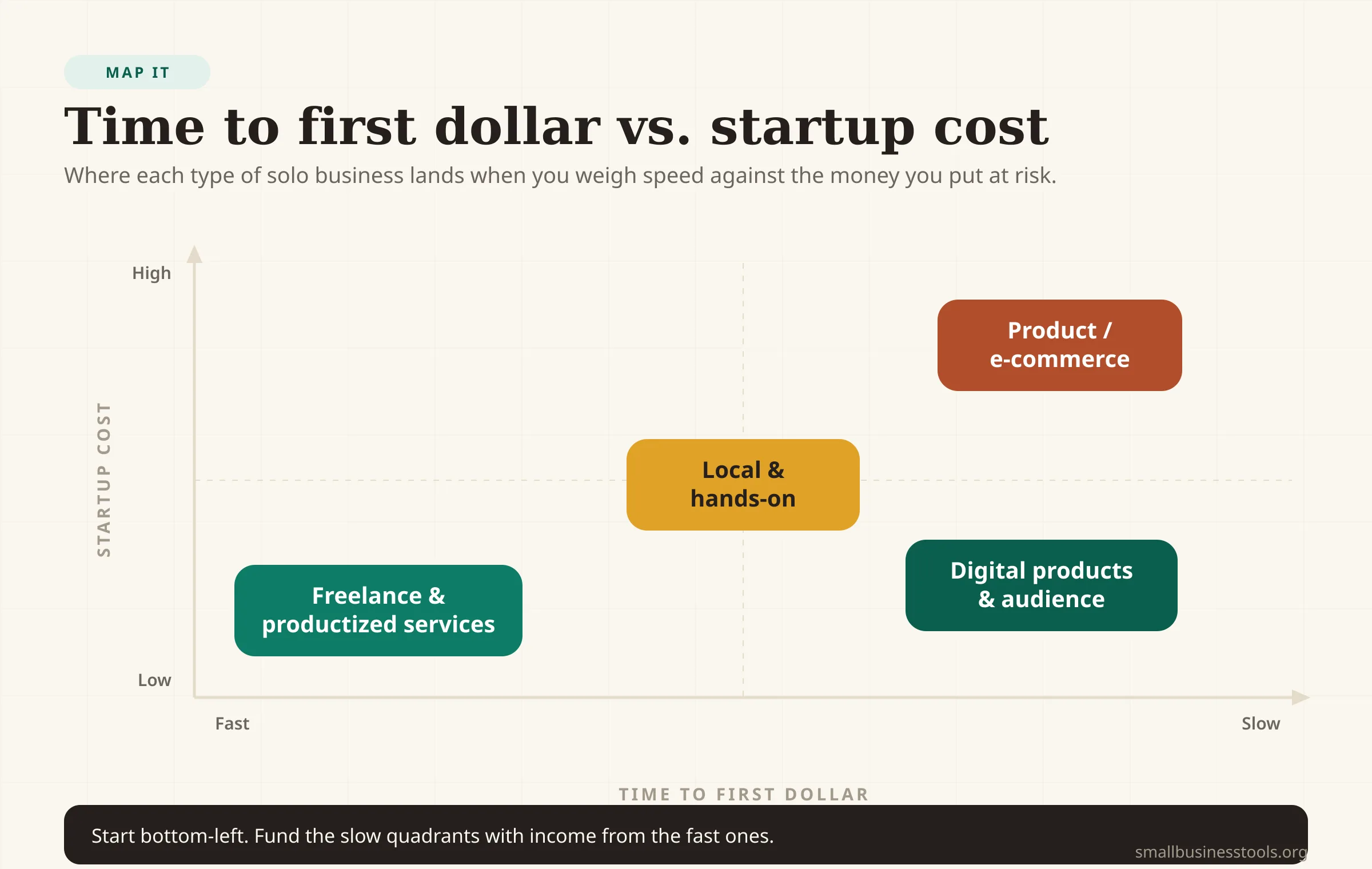
These are the fastest path to revenue for most people, because you are selling time and skill you already have. Startup cost is close to zero — the constraint is finding the first three clients.
| Idea | Startup cost | Time to first client | Recurring? |
|---|---|---|---|
| Bookkeeping / catch-up cleanups | Under $200 | 1–3 weeks | Yes (monthly) |
| Freelance copywriting | Under $100 | 1–4 weeks | Sometimes |
| Social media management | Under $200 | 2–4 weeks | Yes (monthly) |
| Virtual assistant | Under $100 | 1–2 weeks | Yes (monthly) |
| Local SEO consulting | Under $300 | 2–6 weeks | Yes (monthly) |
| Resume & LinkedIn writing | Under $100 | 1–2 weeks | No (repeat) |
| Bookkeeper for one trade (e.g. contractors) | Under $200 | 2–4 weeks | Yes (monthly) |
The pattern that works: pick one narrow customer type, not "small businesses." "Bookkeeping for plumbers" beats "bookkeeping" every time, because the plumber sees a specialist who already understands their world. Narrowing the audience is the single highest-leverage move a solopreneur can make, and it is exactly what the niche approach in our most profitable small business niches guide is built on.
Before you quote anyone, run your target income through the Hourly Rate Calculator. Most first-time freelancers price by "what feels okay" and end up underwater once you subtract taxes, unpaid admin time, and the hours you can't actually bill. Work backward from the income you need instead.
Productized services (a service that sells like a product)
A productized service is a fixed offer at a fixed price with a fixed turnaround — "$1,500 brand identity, delivered in 10 days" instead of "let's scope a custom project." It is the best middle ground for solopreneurs: the delivery is a service, but the buying experience is a product, which means less selling and more repeatable work.
- Website-in-a-week for a specific trade (restaurants, dentists, gyms).
- Monthly newsletter production for coaches and consultants who hate writing.
- Podcast editing at a flat per-episode rate.
- Pitch deck design for founders raising money.
- "Google Business Profile tune-up" — a one-time local SEO package for brick-and-mortar shops.
- Product photography day for e-commerce sellers, flat rate per 20 shots.
The advantage: you write the sales page once, and every buyer gets the same scope. That predictability lets you actually calculate your margin instead of guessing. Price it, then check the math on the Profit Margin Calculator — a productized service with no margin after your own time is just a job with extra steps.
Local and hands-on businesses
Not every solopreneur wants a laptop business, and local demand is often less competitive than online. These need a little more startup cash for equipment but reward reliability over marketing genius.
- Mobile car detailing — van, supplies, and a booking link.
- Pressure washing — driveways, decks, storefronts; high repeat demand.
- Handyman / small-job specialist — the jobs contractors won't take.
- Cleaning service (residential or post-construction).
- Lawn care and seasonal yard work.
- Pet sitting and dog walking — near-zero startup cost, strong repeat.
- Junk hauling and small moves.
These win on trust and consistency, not cleverness. The owner who answers the phone, shows up on time, and sends a clean invoice will out-earn a "better" competitor who does none of those. A tidy, professional invoice and a QR code on your van that links straight to your booking page (QR Code Generator) do more for a local business than any ad.
Digital products and audience businesses
These have the best long-term economics — you build once and sell many times — but they are the slowest to first dollar and depend on an audience or an SEO position you don't have yet. Treat them as a second act, funded by a service business, not a first move.
- Templates and digital downloads (Notion templates, spreadsheets, design assets).
- A niche newsletter with sponsorships or a paid tier.
- An online course teaching the exact skill your service clients pay you for.
- A small SaaS or micro-tool solving one annoying problem in a niche you know.
- A content site monetized with affiliates and ads.
The honest caveat: "build an audience" is not a plan you can execute on a deadline. Most solopreneurs who succeed with digital products earned the audience by doing the service work first, in public, for a specific niche. If this is the dream, start the service business now and build the audience on the side.
The 27 ideas at a glance
Combining the sections above, here is the full shortlist with the fastest-to-revenue ideas first:
- Bookkeeping / catch-up cleanups
- Virtual assistant
- Resume & LinkedIn writing
- Freelance copywriting
- Pet sitting & dog walking
- Social media management
- Local SEO consulting
- Handyman / small-job specialist
- Cleaning service
- Mobile car detailing
- Pressure washing
- Lawn care
- Junk hauling
- Website-in-a-week (niche)
- Podcast editing
- Newsletter production service
- Pitch deck design
- Google Business Profile tune-ups
- Product photography days
- Bookkeeping for one trade
- Notion / spreadsheet templates
- Niche newsletter
- Online course
- Micro-SaaS / niche tool
- Affiliate content site
- Email marketing for local shops
- Fractional "ops" help for tiny teams
Common mistakes solopreneurs make picking an idea
- Chasing the biggest market instead of the reachable one. You don't need millions of customers. You need the next ten, and they need to be people you can actually find.
- Pricing to be the cheapest. The cheapest solopreneur attracts the worst clients and burns out. Price for the income you need — the Hourly Rate Calculator shows you what that number really is.
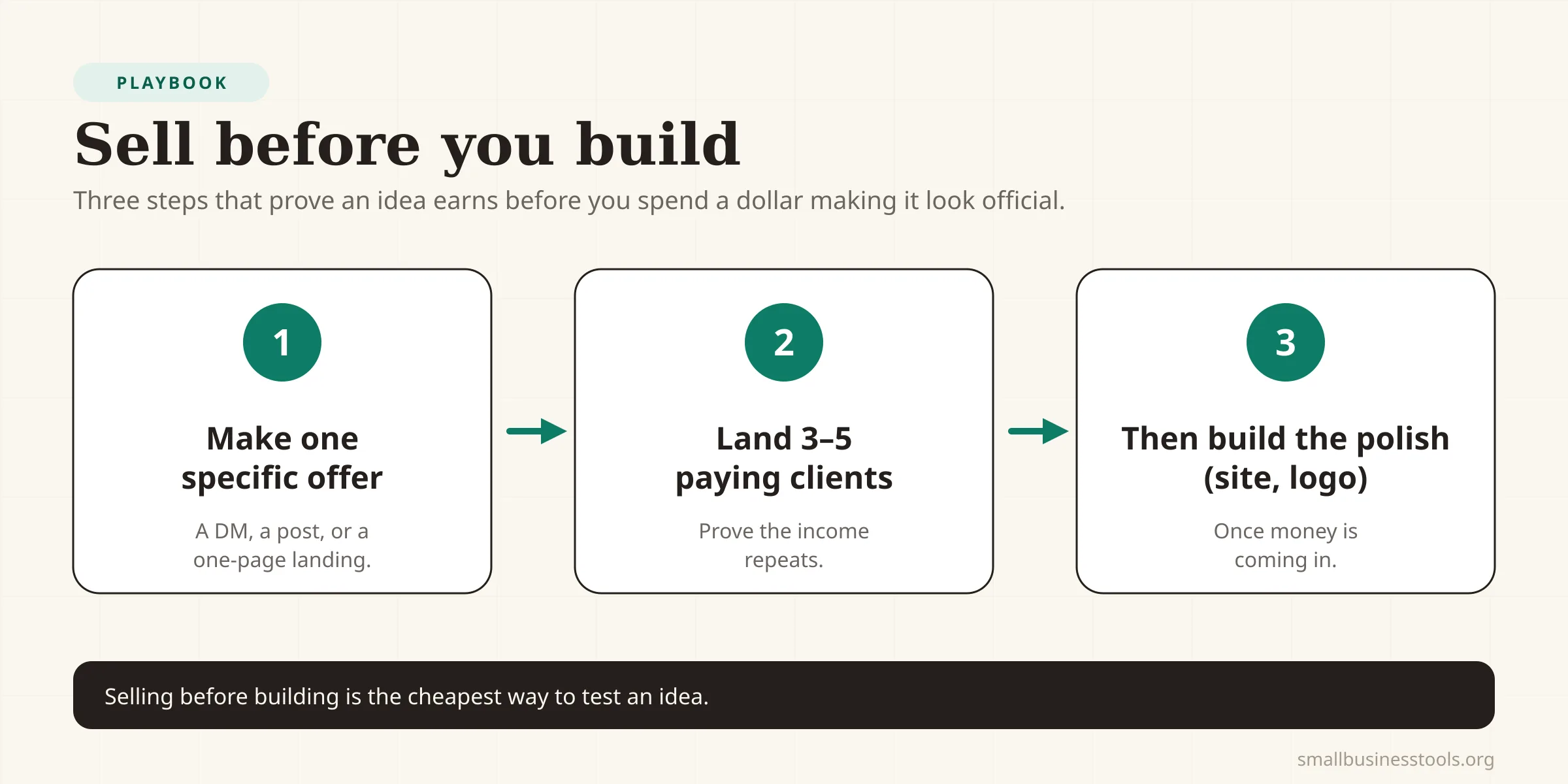
- Building before selling. A logo, a website, and business cards feel like progress but earn nothing. Sell the offer first — even with a spreadsheet and a phone — then build the polish once money is coming in.
- Staying vague. "I help small businesses" is not an offer. "I do the monthly books for plumbing and HVAC contractors" is. Specific gets referred; vague gets forgotten.
FAQs
What is the cheapest small business to start as a solopreneur?+
Service businesses that sell a skill you already have — bookkeeping, writing, virtual assistance, pet sitting — can start for under $200, since your main cost is your own time. Avoid anything that requires inventory or equipment as your first move.
What small business idea makes money the fastest?+
Productized and freelance services reach the first paying customer fastest, often within one to three weeks, because you can sell the offer before you build anything. Product and audience businesses are far slower and are better started as a second income stream.
Do I need an LLC to start?+
In most places you can start as a sole proprietor and earn money immediately, then form an LLC once revenue is steady and you want liability protection. Don't let entity paperwork delay your first sale — but do check your local rules and set aside money for taxes from day one.
How do I choose between two ideas?+
Score each on time-to-first-dollar, startup cost you can afford to lose, and whether the revenue repeats. The one that scores best on all three — not the one that sounds most exciting — is usually the right first move. The [Business Niche Finder](/tools/business-niche-finder) can help you sharpen a broad idea into a specific, testable one.
Should I quit my job first?+
No. The lowest-risk path is to start the service on the side, land three to five clients, and prove the income is repeatable before you leave a paycheck. Solopreneur businesses are cheap enough to test that you rarely need to bet your rent to find out if one works.
Final take
The best small business idea for you is the intersection of a skill you already have, a specific customer you can actually reach, and an offer that repeats. Start there, sell before you build, and price for the income you need — not the price that feels safe. Use the Business Ideas Generator to break the blank page, the Business Niche Finder to get specific, and the Hourly Rate Calculator to make sure the numbers work before you quote a single client.
Free tools to try
Business Niche Finder
5 specific niches matched to your skills — with the first offer and a cheap way to validate each.
Business Ideas Generator
8 realistic business ideas matched to your skills, budget, and time — with a first step for each.
Hourly Rate Calculator
Find the hourly rate freelancers and consultants must charge to hit their income goal.
Keep reading
Guide
Untapped Small Business Niches: 18 Underserved Markets
18 untapped small business niches where demand outruns supply. How to spot an underserved market, validate it in a week, and own it before competitors notice.
Guide
Most Profitable Small Business Niches (And the Math Behind Them)
The most profitable small business niches for solopreneurs and small teams — ranked by real margin, not revenue. Plus how to check the profitability of any idea.
Guide
Best LLC Formation Services (2026)
11 LLC services ranked honestly for leverage — real prices, registered-agent renewal traps decoded, and the $0 DIY baseline for the simplest cases.