Email Marketing
Constant Contact
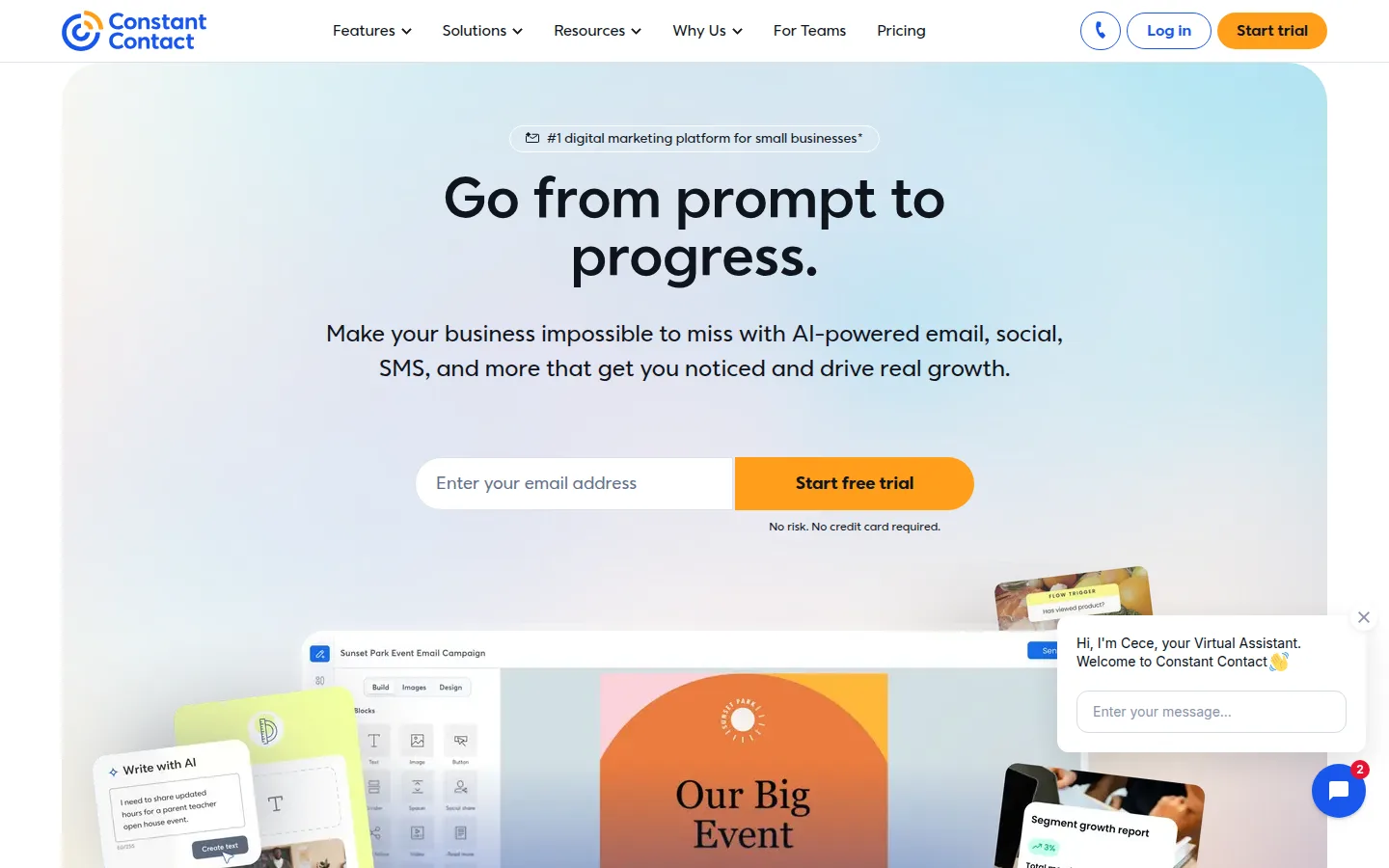
Constant Contact is the email platform built for the smallest end of small business: template-driven campaigns, event management, and SMS in one tool, aimed at owners and nonprofit coordinators who don't want to think about "marketing automation" as a discipline. In June 2026 it even shipped an app inside ChatGPT for drafting campaigns conversationally, per the company's announcement.
Its trade-off is depth: automation is thinner than rivals at the same price, and there's no free plan — just a trial.
- Website
- constantcontact.com
- Category
- Email Marketing
- Pricing
- Paid
- Starts at
- ~$12/month (Lite, 500 contacts)
- Best for
- Local businesses and nonprofits that want easy email plus events and SMS, with support a phone call away.
- Profile updated
- July 16, 2026
Independent profile — no affiliate links or sponsored placement.
Key features
- Drag-and-drop campaigns with a large template library and AI content generation
- SMS marketing (US and, since June 2026, Australia) with dynamic-segment targeting added in March 2026
- Event management — invitations, registrations, and tracking, a genuine differentiator
- Social posting, scheduling, and ads from the same dashboard
- Automation flows (about 3 on Standard; unlimited on Premium) with resend-to-non-openers
- Landing pages and signup forms
Pricing
As of July 2026, figures consistently reported by third-party pricing guides (Constant Contact's own pricing page blocks automated checks — confirm current numbers on constantcontact.com/pricing):
- Lite — ~$12/month at 500 contacts
- Standard — ~$35/month at 500 contacts
- Premium — ~$80/month at 500 contacts
Prices scale with contact count (roughly $110/month Standard at 5,000 contacts). Annual prepay saves up to 15%, nonprofits up to 30%. No free plan.
Pros and cons
Pros
- Genuinely easy for non-marketers; phone support is part of the pitch
- Events + email + SMS in one tool suits local businesses and nonprofits
- Nonprofit discounts are meaningful
Cons
- No free plan, and the trial terms have shifted over time
- Automation is shallow until the Premium tier
- Per-contact pricing climbs steeply as lists grow
Who should use Constant Contact?
The classic Constant Contact customer runs a restaurant, a retail shop, a class studio, or a nonprofit: they send a newsletter, promote events, and occasionally text customers — and they'd rather call support than read documentation. Power users who want deep segmentation and journeys will hit the ceiling and should look at ActiveCampaign or GetResponse instead.
Rating, for context: 4.3/5 on Capterra (2,800+ reviews) — as of July 2026.
FAQs
Does Constant Contact have a free plan?+
No. It's paid-only with a trial (trial terms have varied; recent third-party guides describe a 14-day trial). Entry pricing starts around $12/month for 500 contacts on the Lite plan.
Is Constant Contact good for nonprofits?+
It's one of the most popular choices — event tools, easy delegation to volunteers, and up to 30% prepay discounts for nonprofits make it a natural fit.
Constant Contact or Mailchimp?+
Constant Contact wins on events, SMS, and hand-holding; Mailchimp wins on templates, integrations, and reporting depth. At similar list sizes their paid pricing is comparable, so choose by which extras you'll actually use.
Similar tools in the directory
Email Marketing
Mailchimp
Small businesses that want the most familiar email platform and the deepest template and integration ecosystem.
Email Marketing
Brevo
Businesses with a big contact list that email occasionally — you pay for volume sent, not list size.
Email Marketing
GetResponse
Creators and small businesses that want email plus webinars, landing pages, and online-course tools in one subscription.
Free tools to try
Keep reading
Guide
Best Free Email Marketing Tools for Small Business (2026)
12 free email marketing tools ranked by what you really get free after 2026's big plan cuts — Kit, Sender, Brevo, Mailchimp and more, with real limits.
Guide
Free Small Business Tools (No Signup): The Complete List
A directory of free small business tools — pricing calculators, invoicing, marketing, SEO, and writing. No signup, no paywall, and they explain the math.